Sermon Translation
Sermon Translation That Helps Everyone Follow the Message
Sermon translation makes spoken teaching understandable to people who worship in another language. Voco turns one clear church audio feed into live translated text in 200+ languages, delivered through one QR code to each attendee's own phone.
The need
Being in the room is not the same as understanding the sermon.
A multilingual guest may follow the welcome, music, and shape of a service while missing the sustained meaning of a thirty-minute sermon. That gap affects discipleship, belonging, and whether a family can participate without depending on one bilingual friend every week.
Sermon translation is the practical response: make the live message available in a language the listener understands well. It can be provided by a human interpreter, prepared translated material, receiver hardware, live translation software, or a thoughtful combination of those options.
The choices
Human, prepared, automated, or hybrid sermon translation?
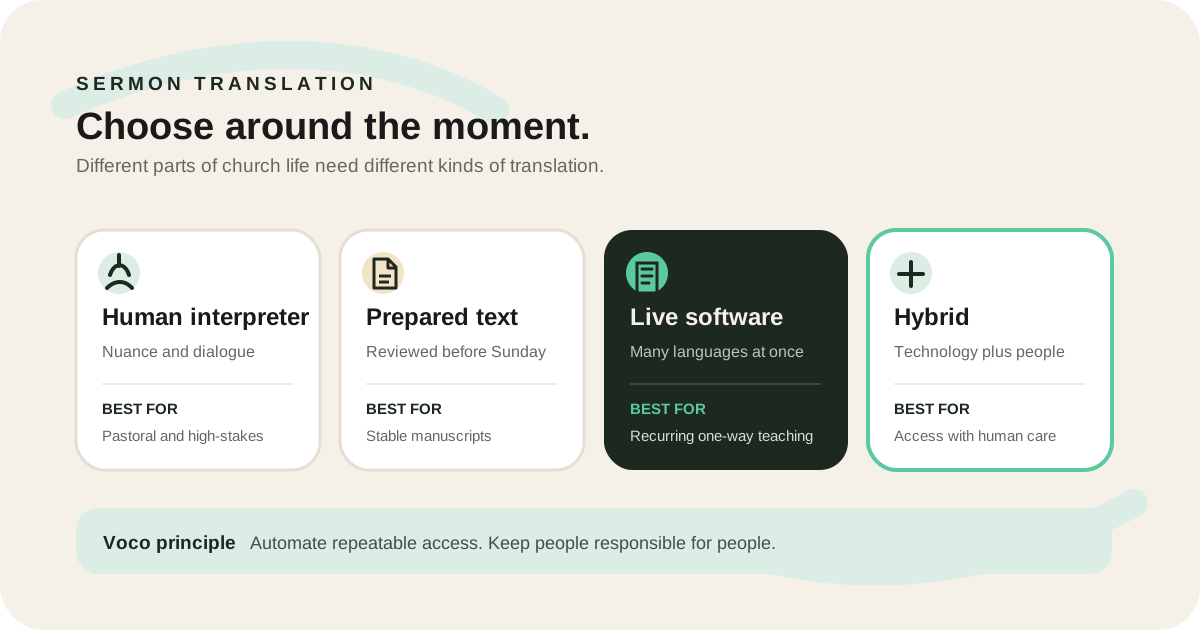
A skilled human interpreter remains the strongest option when tone, cultural context, theological nuance, dialogue, or pastoral judgement carries unusual weight. Prepared translations work well when the complete manuscript is available early, but they cannot follow spontaneous changes. Automated translation is strongest for repeatable one-way teaching, changing language needs, and churches that cannot recruit an interpreter for every language.
Many churches should use a hybrid. Live software can make the main sermon accessible every week, while bilingual leaders or qualified interpreters handle prayer ministry, counselling, safeguarding, funerals, and other moments where relationship and judgement matter more than scale.
Use a human interpreter for sensitive, conversational, or high-stakes ministry.
Use prepared text when the sermon manuscript is genuinely final and can be reviewed in advance.
Use live software when the speaker is amplified clearly and several languages may be needed at once.
Use a hybrid when automated access and human pastoral care both matter.
How it works
From the preacher's microphone to translated text on a phone.
Live AI sermon translation has three stages. First, speech recognition turns the church audio into source-language text. Second, translation converts that text into each selected language. Third, the translated segments are delivered to attendees while the preacher continues speaking.
With Voco, the operator selects the spoken language, checks the microphone or sound-desk feed, and starts the service. Attendees scan the church's reusable QR code, search for their language, and read in a mobile browser. They do not create an account, install an app, or queue for a receiver.
One clean speech feed can serve many attendee languages at the same time.
Each listener privately chooses their own language and text size.
The same live text can also feed supported church display and livestream workflows.
A permanent church link means printed QR materials do not change each Sunday.
Real Voco screens · demonstration data
One Sunday workflow. Two simple views.
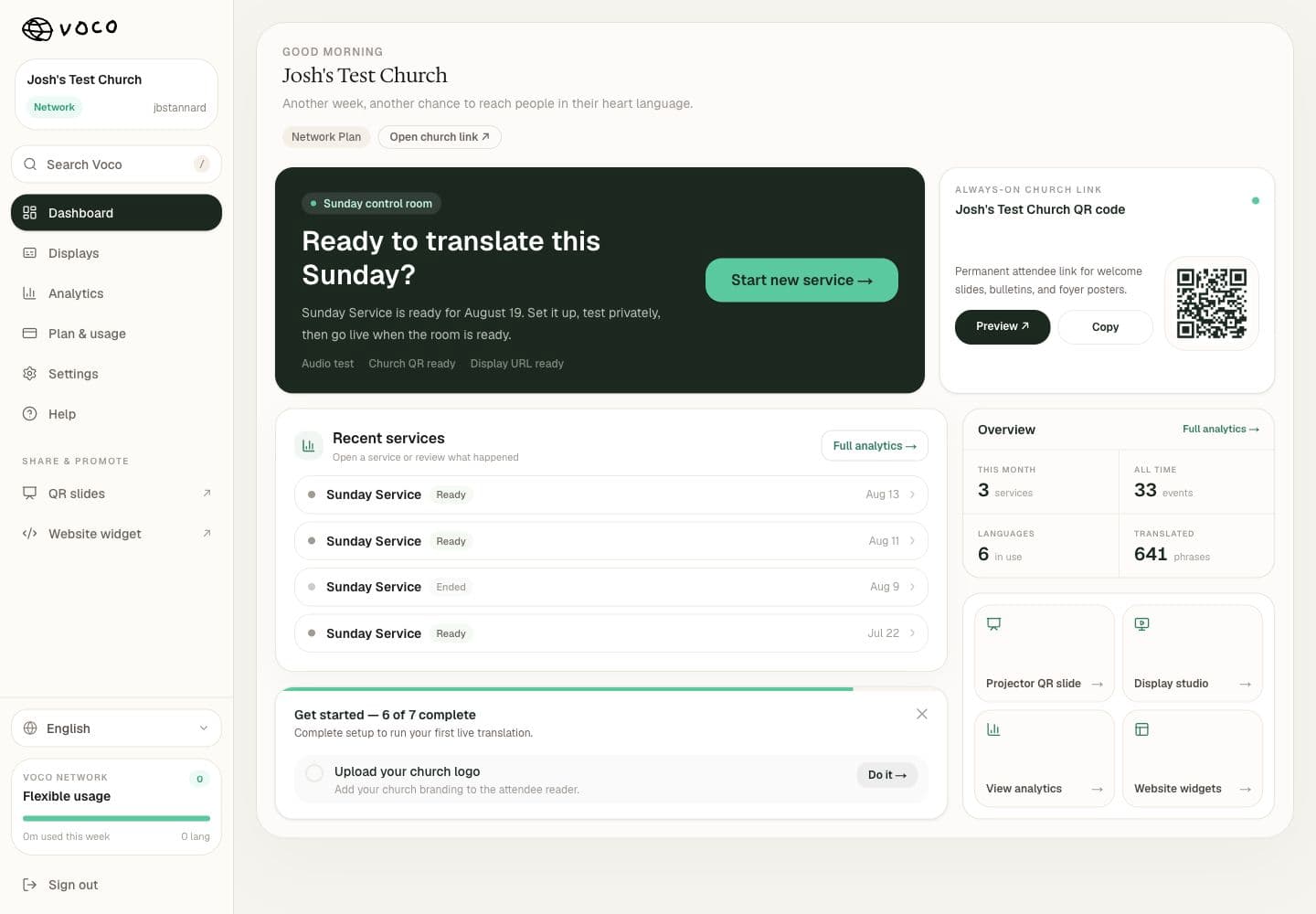
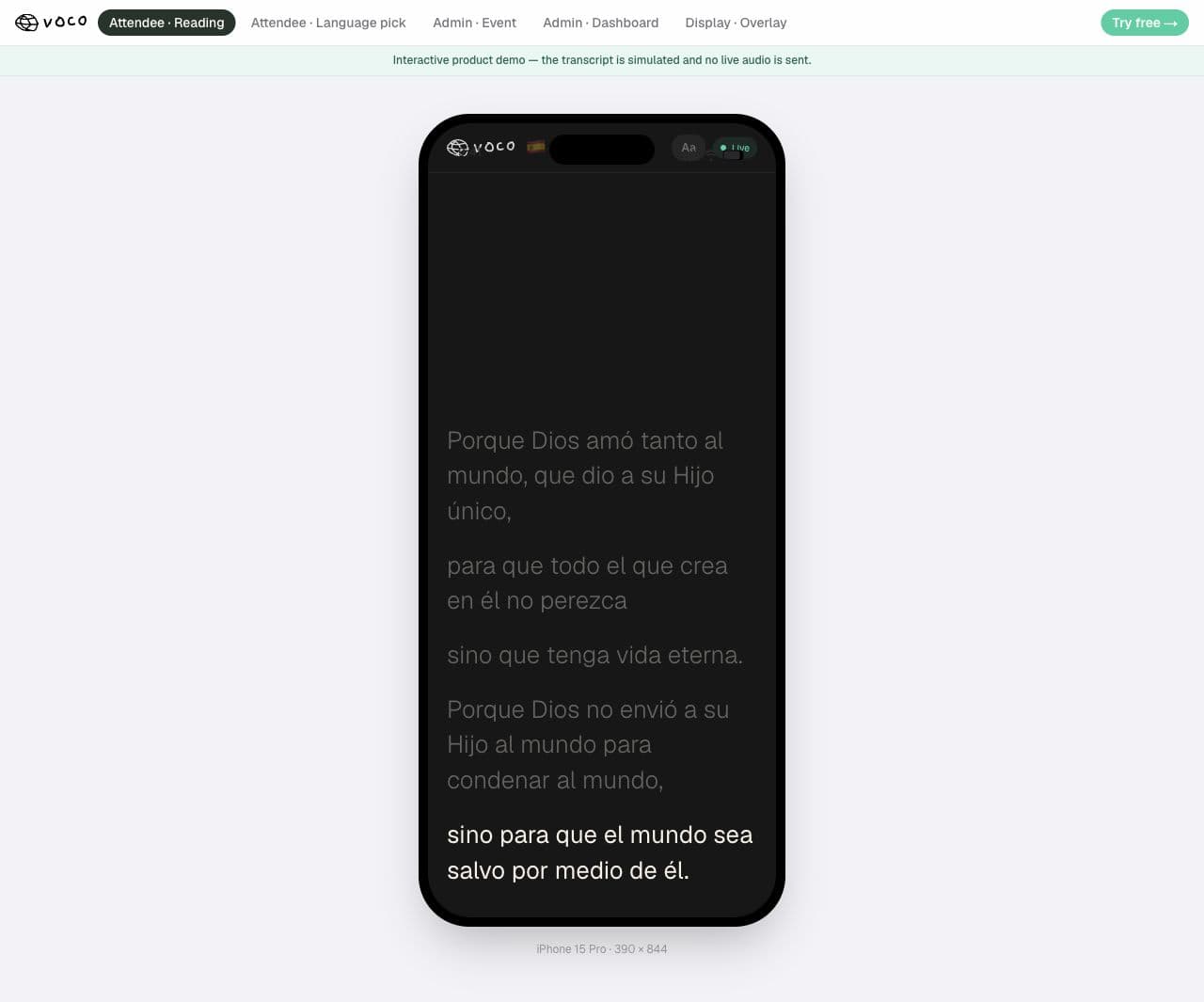
The church team starts and monitors translation from the real Voco dashboard. Attendees scan the permanent QR code and read the sermon in their chosen language—without an app or account.
Accuracy
Translation quality begins before the translation model.
The most important input is clean speech. Echo, music under the speaker, clipped sound-desk levels, distant room microphones, and several people speaking at once can damage the transcript before translation begins. A direct auxiliary feed from the church mixer through a simple USB audio interface is usually the most dependable regular setup.
The other major factor is vocabulary. Pastors use names, local places, Bible books, quotations, theological terms, and denominational language that a general speech model may not expect. Add recurring words to the church glossary, test a complete recorded sermon, and ask a fluent reader whether the meaning remains clear—not merely whether every sentence sounds polished.
Test the normal preacher at their normal pace, not a slow product-demo voice.
Review scripture references, names, church vocabulary, humour, and idioms.
Check priority languages with people who actually use those languages for sustained teaching.
Treat automated output as access support, not an authorised Bible or liturgical edition.
Attendee experience
The best sermon translation is the one a visitor can actually open.
Accuracy is wasted if people cannot discover the translation. Put the QR code on the pre-service screen, a welcome card, the church website, and a small sign near the entrance. Ask the service host or welcome team to mention it once without singling anyone out.
Keep an alternative for people who cannot or do not want to use a smartphone. A church-owned tablet, a shared translated display, printed instructions with a short link, receiver hardware, or a human interpreter may still be appropriate. Accessibility is a choice of workable routes, not a requirement that everybody uses the same device.
Live versus after
Live translation and translated sermon recordings are different jobs.
Live sermon translation helps people participate while the church is gathered. It prioritises low delay, readable segments, reliable delivery, and simple access. Translating a completed recording happens after the service and can prioritise editing, speaker labels, polished subtitles, and a corrected final transcript.
A church publishing translated recordings may use both workflows: live text for Sunday participation, then an edited transcript or subtitle file for the archive. Do not judge a live system only by the standards of a carefully edited video, and do not publish an unreviewed live transcript as though it were a final manuscript.
Buying test
Run one real sermon before choosing a translation platform.
Use Voco's 7-day trial—or any competitor's trial—with at least ten minutes of real church audio. Test the complete chain: sound-desk output, internet connection, source-language selection, QR scan, language search, text arrival, and recovery from a brief interruption.
Then ask a fluent listener three questions: Could you stay with the meaning? Which words repeatedly caused confusion? Would you choose to use this next Sunday? Those answers are more useful than a vendor language count or a perfect two-sentence demonstration.
Test on both iPhone and Android from an ordinary seat in the room.
Include the longest sermon section, not only the welcome announcement.
Compare the operator workload as well as the attendee result.
Write down where a person must remain involved.
Where Voco fits
Voco is built for recurring church teaching, not every interpreting situation.
Voco is a sermon translation platform for churches that want a repeatable Sunday workflow, 200+ attendee languages, browser access, and no per-attendee receiver handout. It is designed so a trained volunteer can start the service and attendees can join without technical help.
Voco is not a replacement for a trusted bilingual leader, a certified interpreter, an approved liturgical translation, or a pastoral conversation. A church should not use automated translation as the only route for safeguarding, counselling, legal matters, or sensitive two-way ministry.
Comparison
| Method | Strongest fit | Main limitation | Typical attendee access |
|---|---|---|---|
| Human interpreter | Nuance, dialogue, pastoral and high-stakes settings | One interpreter is normally needed per spoken language | Headsets, room audio, or in-person interpretation |
| Prepared translation | Final sermon manuscripts available before the service | Cannot follow spontaneous changes reliably | Printed copy, slides, website, or app |
| Live translation software | Recurring one-way teaching across changing languages | Depends on clean audio, connectivity, and language-pair quality | QR code, mobile browser, or shared display |
| Hybrid | Weekly access plus human care for sensitive moments | Requires clear boundaries and volunteer coordination | Software for teaching; people for conversation |
Pricing
Voco Starter
For one main weekly service.
Billed monthly · cancel any time
One main service a week, with one or two regular language groups most Sundays.
Start free trial- One main weekly service
- 1–2 regular language groups
- All 200+ languages available
- Unlimited attendees
- QR code, church link & transcript
Voco Church
For your normal church week.
Billed monthly · cancel any time
Sunday morning, Sunday evening, occasional midweek, every language group, screens, and a small team.
Start free trial- Multiple Sunday services plus the odd midweek
- Unlimited languages across all 200+ options
- Around 5 live hours/week guidance
- No mid-service cut-offs
- OBS, ProPresenter & 3 team seats
Voco Pro
For busy churches using translation across the week.
Billed monthly · cancel any time
Regular midweek meetings, small groups, event weekends, more team members, and no live-hour guidance.
Start free trial- Regular midweek, small groups & event weekends
- Unlimited live hours
- Unlimited languages across all 200+ options
- Signal API for Stream Deck & AV remotes
- Unlimited team seats
Voco Grace Promise
No mid-service cut-offs.
No mid-service cut-offs. Plans describe your normal rhythm, not a hard wall: occasional visitors, longer services, and one-off church events are fine.If that becomes your regular pattern, we'll help you move to the right tier.
Related pages
FAQ
What is sermon translation?
Sermon translation makes a preacher's spoken message understandable in another language. It may be delivered by a human interpreter, prepared translated text, live translation software, or a combination of those methods.
Can AI translate a sermon live?
Yes. Live systems transcribe the speaker, translate short text segments, and deliver them while the sermon continues. Results depend on the source language, target language, audio quality, accent, pace, vocabulary, and speaking conditions, so churches should test priority languages with fluent readers.
Does every attendee need a sermon translation app?
Not with Voco. Attendees scan one QR code and use the reader in their existing mobile browser. The church operator uses the dashboard, but listeners do not install an app or create an account.
Is a human interpreter more accurate than AI sermon translation?
A skilled interpreter is generally stronger for nuance, dialogue, cultural context, and high-stakes ministry. Automated translation can be more practical for recurring one-way teaching, several simultaneous languages, or churches that cannot recruit an interpreter for every need.
How many sermon translation languages does Voco offer?
Voco offers 200+ attendee output languages. Spoken input support is narrower than output support, and quality is not identical across every language pair. Check the language table and test the languages your congregation relies on.
What equipment is needed for live sermon translation?
A phone or laptop microphone is enough for an initial test. For regular services, a clean sound-desk feed through a USB audio interface usually gives stronger transcription. Voco does not require specialist receiver packs or interpreter booths for attendees who use the browser reader.
Can sermon translation be displayed in ProPresenter or OBS?
Voco supports browser-based display workflows for compatible church presentation and livestream tools. Test the selected caption view, font size, contrast, and latency on the actual output before a service.
When should a church not use automated sermon translation?
Do not make automated translation the only route for safeguarding, counselling, legal matters, confidential pastoral care, sensitive two-way prayer, or situations where an error could cause serious harm. Use a trusted bilingual person or qualified interpreter.
Ready this Sunday
Test sermon translation with the voice and audio your church actually uses.
Run a private check, invite a fluent listener, and see whether the message remains clear before using it on Sunday.