AI Church Translation
AI Church Translation: What It Can Do, Where It Struggles, and How to Use It Well
AI church translation can turn one live sermon into readable text in several languages without a separate interpreter rota for every language. It is strongest for clear, one-way teaching and weakest where voices overlap, language is highly specialised, or a sensitive conversation needs human judgement. The useful question is not whether AI is universally good or bad. It is whether it is the right layer for this moment in your church.
What it means
AI church translation begins with speech recognition, then translates the text.
A live system does not translate sound in one mysterious step. It first listens to the speaker and produces a transcript. That transcript is then translated into the attendee's selected language and delivered to their reader. If the first transcript mishears a name, Bible book, place, or theological term, the translation inherits the mistake.
Voco supports 70+ spoken input languages and 200+ attendee output languages. Those counts describe availability, not identical quality in every pair. Accent, pace, room acoustics, microphone placement, language pair, and vocabulary all affect the result.
Best use
It is most useful for repeatable, one-way teaching.
Sermons, Bible teaching, welcomes, notices, and prepared presentations give automated translation a clear speaker and a continuous thread. This makes them a better fit than a prayer circle with several voices or a panel with frequent interruptions. A human interpreter is also safer for pastoral conversations where tone and privacy matter as much as the words.
The practical advantage is consistency. A volunteer can start one session, and several language groups can follow without the church finding a different interpreter and receiver channel for each group. That can make weekly language access possible where the alternatives only work for occasional events.
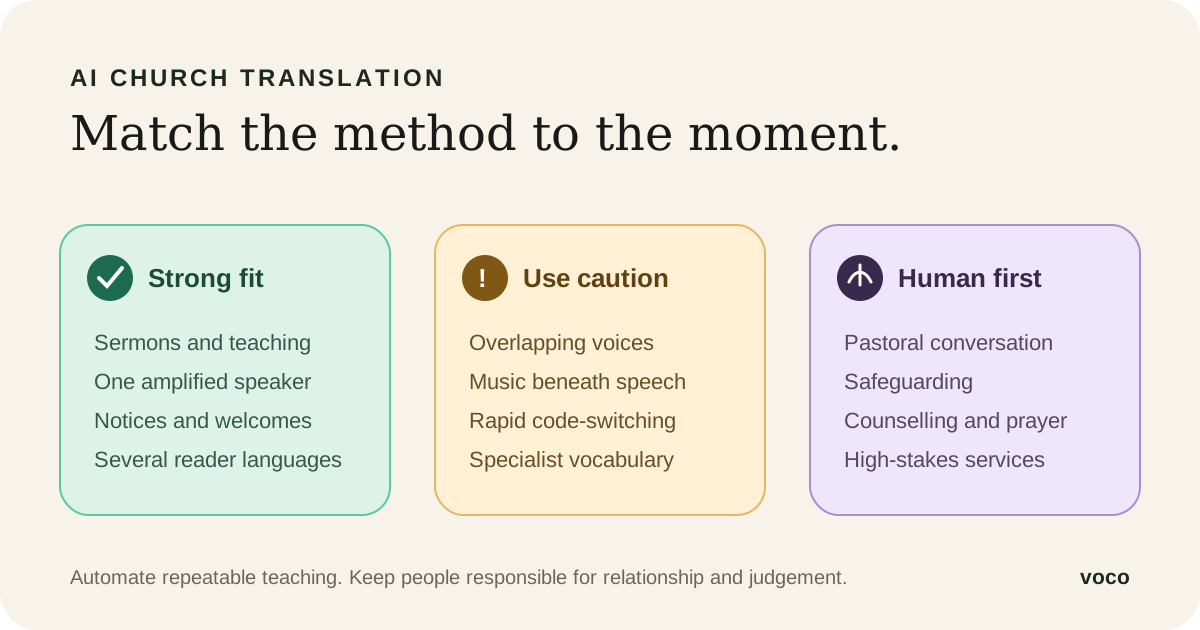
Good fit: sermons, teaching, welcomes, notices, training, and one clear amplified speaker.
Use caution: spontaneous prayer, rapid code-switching, music under speech, panels, and overlapping voices.
Prefer a human: safeguarding, counselling, confession, legal or medical information, funerals, and two-way pastoral care.
Accuracy
Clean speech and church vocabulary matter more than a headline accuracy score.
Vendor accuracy percentages rarely predict what one congregation will experience. A test sentence spoken into a laptop in a quiet office is not a Sunday sermon through a reverberant room. The only useful pre-launch test uses the same preacher, microphone, sound-desk route, speaking pace, and priority languages that the church expects to use live.
Names and recurring terminology deserve special attention. Add the pastor's name, church name, local places, sermon series, Bible books, and denominational vocabulary to the glossary. Then ask a fluent listener to review meaning over ten continuous minutes rather than approving one impressive sentence.
Human safeguard
AI can widen access without pretending to replace pastoral presence.
A translated reader helps someone follow teaching, but it cannot notice distress, understand a safeguarding disclosure, clarify an ambiguous answer, or carry pastoral responsibility. Churches should publish a clear route to a trusted bilingual person or interpreter for moments where misunderstanding could cause harm.
That hybrid approach is often the strongest model: automation for the repeatable broadcast layer, people for relationship and judgement. It also avoids placing the whole weekly sermon burden on one bilingual member while still honouring their language and insight.
Sunday workflow
The attendee should experience a QR code, a language choice, and readable live text—not the AI stack.
Church teams may care about providers and models, but attendees care about whether they can join quickly and keep up. Voco keeps the reader browser-based: the church shows a permanent QR code, each person selects a language privately, and translated segments appear on the device they already have.
Keep one second phone open in a priority language during the service. If text stops arriving or becomes difficult to follow, the operator can see it without asking attendees to report a problem publicly.
Buying test
Judge the complete service, not the model demonstration.
Use the 7-day trial to test one full sermon recording, one live rehearsal, and one ordinary service. Include Scripture references, stories, names, humour, prayer, and the preacher's normal pace.
Afterwards, ask fluent listeners where they lost the meaning, whether the reading pace was comfortable, and whether they discovered the QR code without help. Those answers are stronger evidence than a generic benchmark or a vendor's best-language demo.
Test direct sound-desk audio and a fallback microphone route.
Review at least one high-priority language with a fluent reader.
Record repeated errors and update the glossary before the next service.
Keep the human escalation route visible and easy to use.
Cost
AI translation is usually priced for repeatability rather than individual seats.
Voco Starter begins at £6 per week with unlimited attendees. Compare that with the full cost of each alternative. Include interpreter time for every language, receiver equipment, batteries, cleaning, storage, and volunteer work. Also consider what happens when a new visitor needs a language the church cannot yet support.
Price is not the only criterion. A free bilingual volunteer may be the best solution for one stable language if they want the role and receive appropriate support. Software becomes more valuable as languages change, several groups need access at once, or the same volunteer is unable to participate because they must interpret every week.
Related pages
FAQ
Can AI church translation work in a normal Sunday service?
Yes. It is strongest when one speaker uses a clear amplified microphone for a sermon, welcome, notice, or teaching session. Rehearse with real sermon audio and ask a fluent listener in each priority language to review whether they can follow the meaning.
Does AI translate the audio directly?
The live workflow first transcribes the spoken audio into text and then translates that text. Clear source audio is therefore essential: transcription errors in names, Scripture references, or church vocabulary can flow into every translated language.
Should AI replace a human church interpreter?
Not universally. AI is useful for repeatable one-way teaching across several languages. Human interpreters remain the safer choice for dialogue, pastoral care, safeguarding, counselling, funerals, and any moment where nuance or responsibility is high.
Do attendees need an app or account?
No. With Voco they scan the church QR code, choose a language, and read in their existing phone browser without creating an attendee account.
How should a church test AI translation accuracy?
Run at least ten continuous minutes of a real sermon through the exact microphone and sound route you intend to use. Include names and Scripture, review the result with a fluent listener, add recurring vocabulary to the glossary, and repeat the test.
Is AI church translation only for large churches?
No. Voco Starter begins at £6 per week, and the browser workflow avoids a separate device or licence for every attendee.
Ready this Sunday
See whether AI church translation actually fits your Sunday rhythm.
Test the workflow in your own service before committing to hardware, interpreters, or a larger setup.