
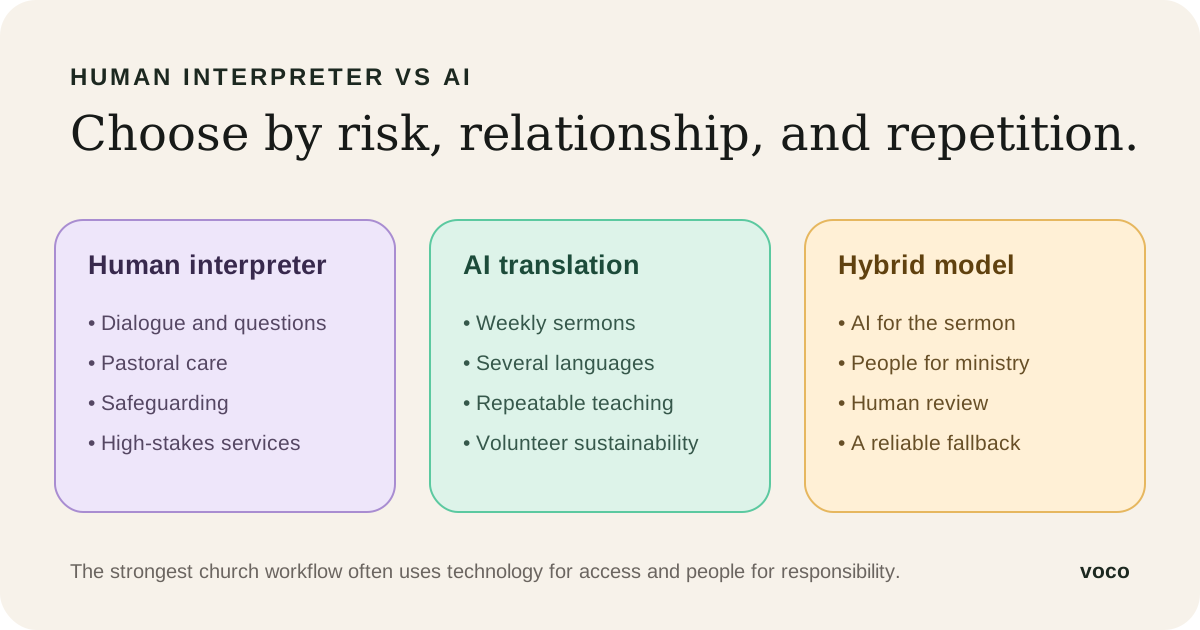
The comparison most churches are actually making
The framing of this question assumes you are choosing between a professional interpreter and software. For a minority of churches that is true. For most, it is not. The realistic comparison is between AI translation and one bilingual member of the congregation who has quietly carried this responsibility for years. That changes the maths completely, because a volunteer looks free and is not. The costs are real, they are just paid in something other than money.
- Reliability — when your interpreter is ill, on holiday, or visiting family abroad, the language group loses access that week with no notice
- Volunteer cost — the person interpreting is not worshipping. Many church interpreters have not sat through a service with their own family in years
- Single point of failure — when one person is the only one who can do a job, that job becomes stressful and hard to hand over
- Language ceiling — you can only offer the languages your volunteers happen to speak, which is rarely the same as the languages in your pews
- Quality variance — willing bilingual speakers are not trained simultaneous interpreters, and sermon content is harder than conversation
What a human interpreter actually costs in 2026
Published vendor rates for on-site interpreting in 2026 run roughly $45-150 per hour, with simultaneous interpretation — the kind where the interpreter speaks at the same time as the preacher — often starting around $100 per hour because it is significantly harder work. Full-day simultaneous assignments are commonly quoted at $1,200-2,500 per interpreter. For a typical Sunday service, once minimum booking hours are applied, most churches see £250-800 or $300-800 per service per language.
- Two interpreters per language, not one — sustained simultaneous work requires a pair rotating every 20-30 minutes, which is the single biggest hidden cost in most quotes
- Minimum booking hours mean a 70-minute service is often billed as two or three hours
- Travel and expenses on top for in-person work; remote interpreting removes this but adds audio latency and technical setup
- Equipment if you want simultaneous rather than consecutive delivery — interpreter console, transmitter and receiver packs run £500-5,000 upfront plus ongoing maintenance and battery replacement
- Preparation time, which interpreters reasonably expect to be paid for, and which improves quality substantially when sermon notes are shared in advance
Cost comparison over a year
The gap is not close for recurring weekly use, which is the honest reason most churches end up looking at AI. Two languages every Sunday with paid professional interpreters lands somewhere around £1,200-2,400 per month. The same coverage with AI translation is typically £25-100 per month depending on provider and plan. Over a year that is roughly £14,000-29,000 against £300-1,200. AI providers currently sit in a fairly narrow band — Glossa from around $5 per hour per language or $99 monthly, OneAccord around $40 per hour or $150 monthly for five hours and five languages, Voco from £6 per week — so the meaningful comparison is against human cost, not between AI vendors.
Accuracy — what AI genuinely gets wrong
Any vendor claiming their AI matches a trained interpreter is overselling. These are the specific, predictable failure modes, and you should test for them before committing to a language:
- Proper nouns — place names, personal names and book titles are frequently mangled, and biblical names are a common casualty
- Denominational and theological vocabulary — words like justification, covenant, sanctification and grace carry precise meaning that generic translation models flatten
- Idiom and illustration — the anecdote that lands beautifully in English often arrives as nonsense in translation
- Rapid or overlapping speech — call-and-response, congregational interjection and two people talking at once degrade transcription badly
- Strong regional accents, which affect the speech-recognition stage before translation even begins
- Low-resource languages — output quality drops sharply outside major world languages, and confident-sounding wrong output is worse than obviously broken output
How those problems get mitigated
The gap narrows when the tool is built for church use rather than general meetings. Voco addresses several of these directly: a biblical glossary lets you pin how specific theological terms are translated rather than accepting the generic model output, and scripture detection recognises a spoken reference like John 3:16 and inserts the officially published translation in the target language rather than round-tripping the English wording. Boosted-word settings improve recognition of names your church uses often — the pastor, the building, the neighbourhood. None of this makes AI equivalent to a skilled interpreter. It does close the most visible and most embarrassing gaps.
When you should still hire a human
There are situations where the honest answer is that AI is not the right tool, and a company selling AI ought to say so plainly. Choose a human interpreter when:
- The service is high-stakes and emotionally weighted — funerals, weddings, baptisms, ordinations. Text on a phone is the wrong medium for a moment someone will remember for the rest of their life
- The content is theologically dense or built on close reading of a passage, where a flattened translation changes the meaning
- The language group has low smartphone literacy, limited data access, or is largely elderly — the delivery mechanism has to fit the people, not just the language
- The language is genuinely low-resource and machine output has not been checked by a fluent speaker you trust
- Phone use during the service is culturally discouraged in your congregation, which is a real consideration in some traditions
- The language has no widely used written form, in which case reading is not a viable route at all
The hybrid model most mid-size churches land on
This is the option missing from almost every comparison, and it is what churches tend to settle into once they have tried both. Rather than choosing, they split by service and by language. A human interpreter covers the main Sunday gathering in the largest second language, where the relationship and the audio delivery matter most. AI covers everything else — midweek Bible study, small groups, youth work, the livestream, and the four or five languages that were never going to get an interpreter because no interpreter was available. This also protects your volunteer, because it removes the expectation that one person covers every meeting.
- Human interpreter for the main service in your largest language group
- AI for midweek, small groups, prayer meetings and youth ministry
- AI for the long tail of languages a single volunteer could never cover
- AI as the fallback when your interpreter is away, so access does not disappear that week
- AI on the livestream, where a remote diaspora audience is often larger than the room
How to decide — a short framework
Work through these in order. The answers usually point clearly in one direction:
- 1How many languages do you actually need?One language, one service, and a willing trained interpreter available — human interpretation is viable. Three or more languages, and human interpretation stops being financially or practically possible for almost any church.
- 2How often?A one-off conference or annual celebration justifies paying for professional interpreting. A full year of weekly services does not, at professional rates, for the overwhelming majority of congregations.
- 3Who is doing it now, and at what cost to them?If the answer is one volunteer, ask them privately whether they want to keep doing it. The answer is often no, and they have not felt able to say so.
- 4Does the content need audio, or is reading acceptable?Test this with the actual language group rather than guessing. Some people strongly prefer hearing; others prefer reading and re-reading at their own pace, and appreciate that it is private.
- 5What happens when your interpreter is away?If the honest answer is that access simply stops, you need a fallback regardless of which option you choose as primary.
What this looks like in practice
Two patterns cover most churches. A congregation of around 150 with a growing Spanish-speaking group and one bilingual volunteer typically starts with AI for the sermon so the volunteer can stop interpreting and start worshipping, keeping them involved instead for welcome and pastoral conversation where a human is irreplaceable. A congregation of around 400 with four language groups — often Spanish, Portuguese, Farsi and Mandarin in a UK city — usually cannot staff that with interpreters at any realistic budget, so AI becomes the only route to covering all four, with a human interpreter retained for the largest group and for major services in the church calendar.
How to test before you commit
Do not make this decision from a comparison table, including this one. Run one rehearsal. Play a recorded sermon through your actual audio setup, have a fluent speaker of the target language read the output on a phone, and ask them a direct question: could you follow the argument, and did anything come through wrong enough to be distracting? That single test tells you more than any vendor page, and it takes twenty minutes. Most providers offer a free trial specifically so you can do it — Voco has a seven-day trial with no card required.