Baptist church guide
Baptist church translation for sermons, Scripture, and invitations
In many Baptist churches, the sermon carries a large share of the service’s spoken content. That makes sustained accuracy, Scripture references, theological vocabulary, and a dependable volunteer workflow more important than a flashy demo.

By Josh Stannard, Founder of Voco
Building practical live translation for churches. Updated August 2026.
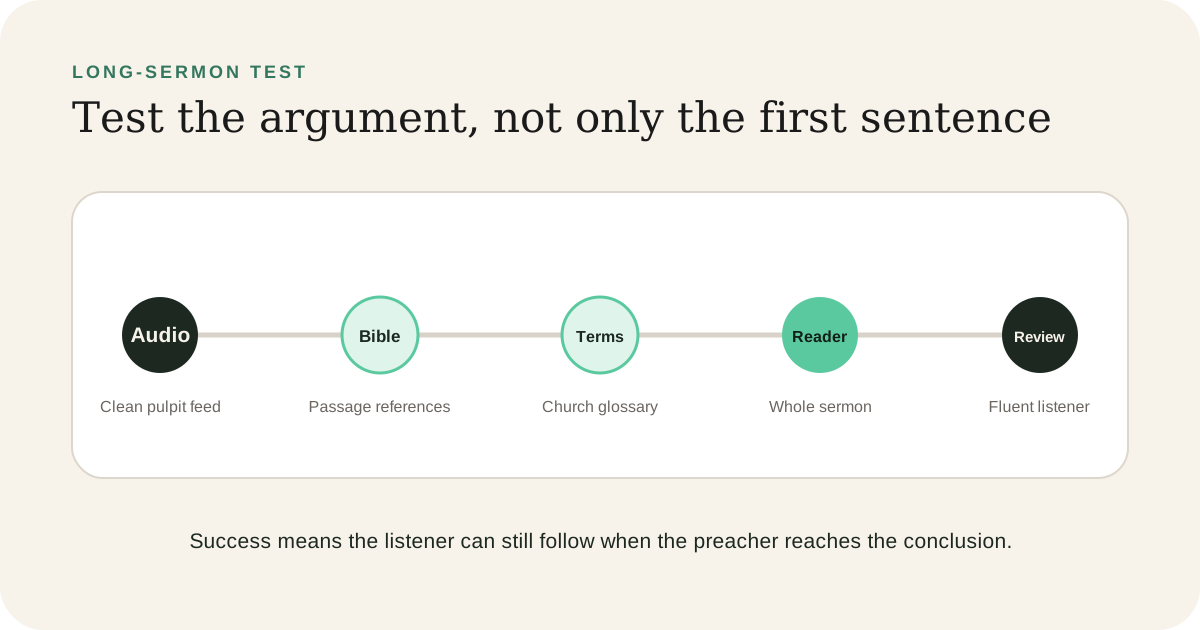
Optimise for the whole sermon, not a thirty-second demonstration
Short product demos hide the difficult parts of Baptist preaching: a forty-minute exposition, movement between several passages, repeated key phrases, stories, quotations, and a closing appeal. Test with a real archived sermon from your pastor, including the introduction and response.
Ask a fluent reader to note where meaning drifted, where a sentence arrived too late to follow, and where a theological term changed from one paragraph to the next. A successful trial is not merely text appearing on a phone; it is a listener still understanding the argument when the preacher reaches the conclusion.
Prepare Scripture references and recurring doctrine
Add the sermon series, pastor’s name, Bible-book names, local ministries, and recurring theological terms to the glossary. If the preacher supplies notes, use them to identify unfamiliar names and the main passages, but do not upload more personal information than the test requires.
Voco can detect Scripture references in speech, yet live translated wording should not be presented as the congregation’s chosen Bible edition. Where precise Bible wording matters, link or direct the listener to an established translation in their language and let the live reader carry the preacher’s explanation around it.
- Test the pastor’s normal Bible-version abbreviations and pronunciation
- Pin names and recurring doctrinal language in the glossary
- Give reviewers the passage references before evaluating the sermon
- Distinguish the preacher’s paraphrase from an official Bible translation
Keep invitations and response moments understandable
A closing invitation may contain the most pastorally important instructions in the service: where to go, whether to remain seated, who will pray, or how to ask a question. Speak these directions clearly through the microphone and leave enough space for translated text to arrive.
Do not use AI as the only route for a sensitive response. Identify a trusted person who can meet the visitor afterwards, and arrange a human interpreter where a conversation concerns safeguarding, confession, crisis, or detailed spiritual counsel.
Live text can open the door to a conversation; it should not pretend to be the conversation.
Use one access point for every language group
One church QR code opens a browser reader where each person chooses from 200+ attendee languages. That is particularly useful when a Baptist congregation welcomes several small language groups rather than one group large enough to justify receiver hardware.
Attendees do not create an account, and there is no per-listener charge. Advertise the two or three languages people actually use, then add “more languages available after scanning” so occasional visitors do not assume the list is closed.
Keep one or two church-owned tablets for people who cannot comfortably use a phone.
Feed the system clean pulpit audio
Translation quality begins before any AI provider. A pulpit or headset microphone routed into the sound desk provides a much cleaner signal than a laptop hearing the room, band, ventilation, and congregation at once.
Send a dedicated auxiliary or matrix output to a USB audio interface, and make sure the operator selects that input before going live. Test guest preachers separately if they use a handheld microphone or move far from it.
If testimonies are part of the service, bring speakers to a microphone rather than expecting the system to recover distant speech from the pews.
Build language ministry around the reader
Invite the people using translation to shape the provision. Ask which Bible edition they read, which terms sound unnatural, whether the font and text size work, and whether the closing instructions arrived clearly enough to act on.
Give feedback to the preaching and AV teams without identifying individuals in public analytics. As the group grows, translation may reveal the need for a bilingual Bible study, translated membership material, a human interpreter for baptism preparation, or leaders from that language community.
The reader is a bridge into shared church life, not a reason to leave people permanently consuming Sunday through a screen.
A Baptist church buying test that protects the budget
Run two archived sermons and one live rehearsal during the 7-day no-card trial. Review meaning with actual speakers of the target languages, then compare the real volunteer time, audio requirements, and pastoral limitations against a human interpreter or existing headset system.
Voco Starter begins at £6/week for one main service; Church begins at £12/week for multiple services and AV integrations. The right decision is not the cheapest headline—it is the least expensive workflow your church can run faithfully every week.
Frequently asked questions
Will Voco handle a forty-minute Baptist sermon?
That is the correct way to test it. Use a real full-length sermon, a clean audio feed, and a fluent reviewer. Accuracy and timing vary with the speaker, audio, language pair, and network, so no short demo can answer for your church.
Can it recognise Bible verses?
Voco includes Scripture-reference detection, but the translated live sentence is not a substitute for an established Bible edition. Provide the passage reference so listeners can open the translation their church trusts.
Can several languages run during the same sermon?
Yes. Each attendee chooses their own output language from the same church link. Voco currently lists 200+ output languages, while spoken-input support is a separate 70+ list.
Do visitors need to install an app?
No. They scan the church QR code, open the reader in their phone browser, choose a language, and read. Keep a short URL and church-owned tablet available as alternatives.
Should we still use a human interpreter?
Use one when nuance, two-way conversation, confidentiality, or pastoral risk makes it necessary. AI text is useful for making a public sermon accessible; it is not a universal replacement for human language ministry.
Primary references
Official denominational resources used to verify the service-specific guidance on this page.