
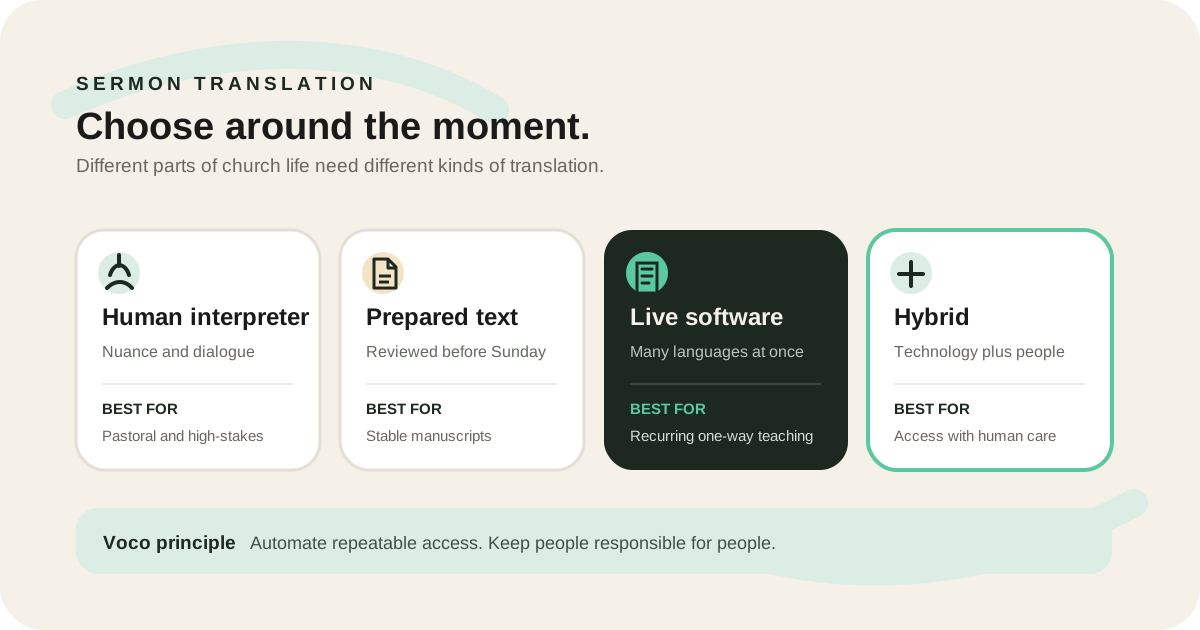
Start with the job, not the provider
The phrase 'church translation services' covers several very different jobs. Translating a written policy is not the same as interpreting a live sermon. Interpreting a counselling conversation is not the same as sending readable sermon text to several phones. Write down what must be understood, when it must be available, whether the conversation is one-way or two-way, and what happens if a phrase is wrong.
- Live sermon or teaching for people in the room
- Two-way pastoral conversation, prayer, or counselling
- Prepared liturgy, sermon manuscript, policy, or safeguarding document
- Livestream captions or translated subtitles for a recording
- Several simultaneous languages or one stable language group
Professional human interpretation
A professional interpreter listens to spoken language and communicates the meaning in another language. Consecutive interpretation pauses between sections; simultaneous interpretation continues while the speaker talks. A skilled church interpreter can carry tone, context, humour, theological vocabulary, and cultural meaning in a way automated systems may miss. Human interpretation is the safer default for counselling, safeguarding, funerals, legal or immigration matters, confidential prayer, and unpredictable two-way conversation.
- Strongest for nuance, dialogue, confidentiality, and pastoral judgement
- May require one interpreter and audio channel for each spoken target language
- Needs preparation, rest, safeguarding boundaries, and sustainable volunteer expectations
- Qualified professional support is appropriate when the consequence of an error is high
Professional document translation
Written translation is the right service for documents that need a stable, reviewed final version. Examples include safeguarding information, membership material, wedding instructions, policies, formal letters, prepared liturgy, and sermon manuscripts that will be published. A translator can research terminology, edit the text, and apply a review process that live output does not have. Use the authorised translation required by your denomination or Bible publisher where a fixed sacred or liturgical text already exists.
Live church translation software
Live software listens to an amplified speaker, produces a transcript, translates short segments, and delivers them while the service continues. It is strongest for recurring one-way teaching where the church needs several languages, attendance changes, or human interpreters are not available. Voco uses this model: attendees scan one QR code, select a language, and read in their mobile browser.
- Scales one clear speech feed to many attendee languages
- Avoids a separate receiver and interpreter channel for every language
- Depends on clean audio, internet access, and the quality of each language pair
- Should be rehearsed with a fluent reader and real sermon audio
- Does not replace a person in sensitive or conversational ministry
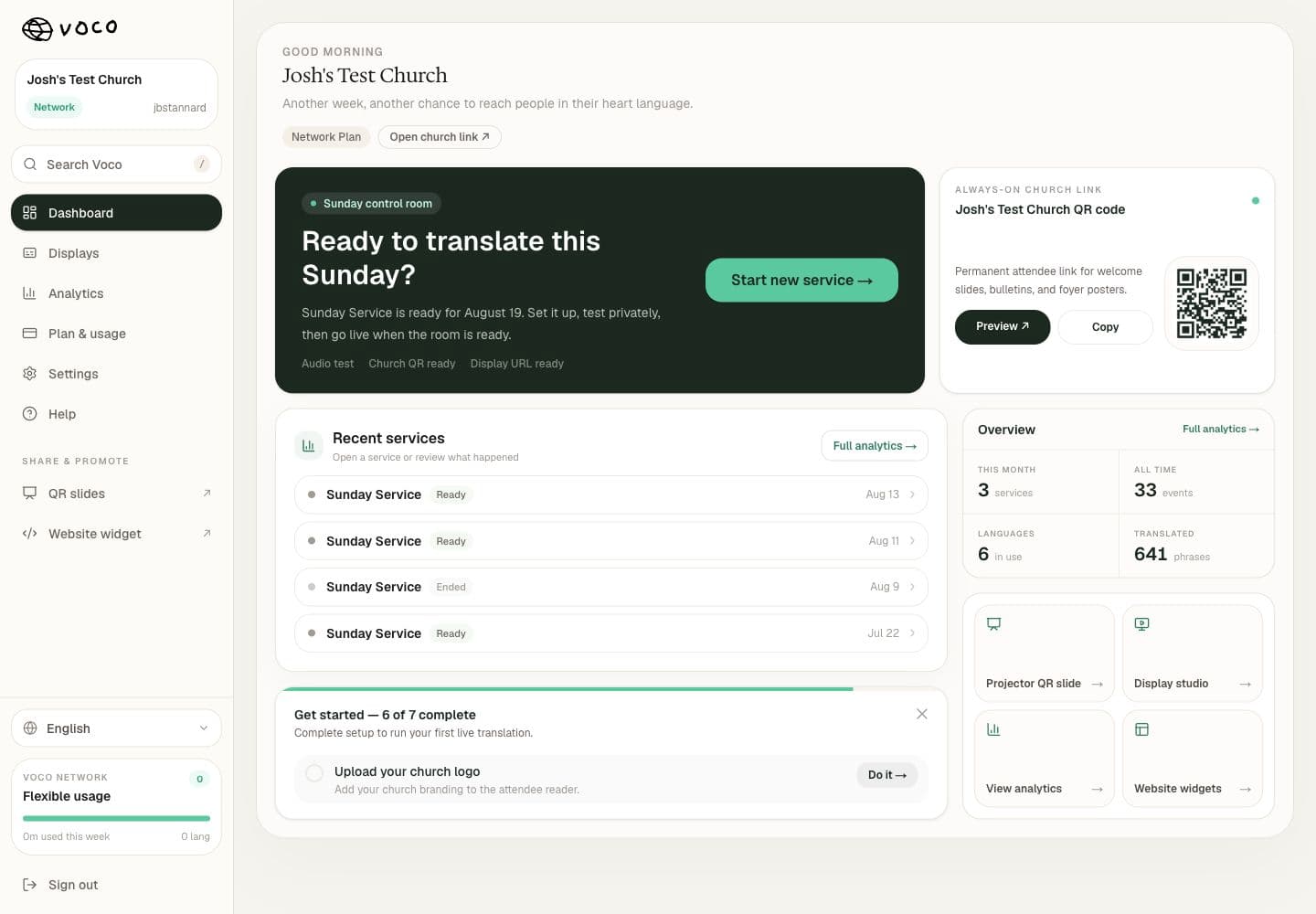
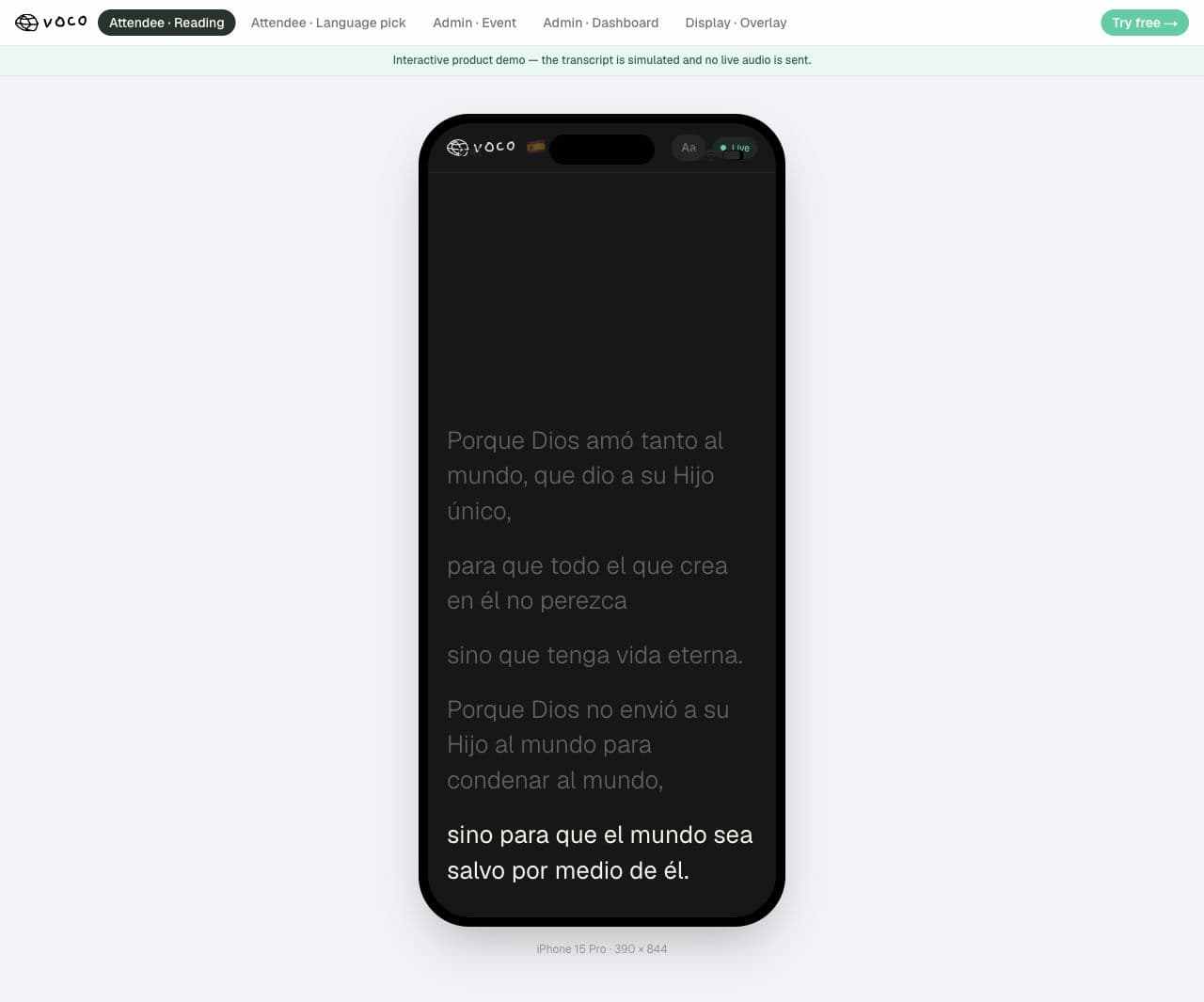
Real Voco screens · demonstration data
One Sunday workflow. Two simple views.
The church team starts and monitors translation from the real Voco dashboard. Attendees scan the permanent QR code and read the sermon in their chosen language—without an app or account.
Managed service or self-serve software?
Some vendors sell a managed event service with technicians, interpreters, equipment, or remote operators. That can be valuable for a major conference, denomination gathering, or one-off event where the organisation wants a supplier to own the workflow. Self-serve software is usually a better fit for an ordinary weekly service when the church already runs its sound desk and wants a repeatable process a volunteer can start.
- Choose managed delivery when the event is complex, high profile, or operational ownership matters most
- Choose self-serve software when the same church team needs a predictable weekly routine
- Price preparation, equipment, travel, technician time, and each language—not only the headline fee
- Ask who monitors the attendee experience and who responds when the audio feed fails
The hybrid model is often the most pastoral
A church does not need to choose people or technology for every moment. Software can make the main sermon accessible each week. Bilingual welcome volunteers can help people join and answer ordinary questions. A trained interpreter can cover counselling, safeguarding, or a significant service. Prepared translations can handle fixed policies and liturgy. Clear boundaries let each method do the work it is actually good at.
- 1Automate repeatable teachingUse live translated text for the sermon, notices, and other one-way amplified speech after a real rehearsal.
- 2Prepare fixed materialUse reviewed written translations for policies, authorised liturgy, and material that will be published or reused.
- 3Keep people responsible for peopleUse trusted bilingual leaders or qualified interpreters for conversation, prayer, safeguarding, and pastoral judgement.
Questions to ask before buying
Ask every provider to demonstrate your real workflow rather than a perfect studio clip. Use the preacher, accent, room, sound-desk feed, priority language, and phone models your congregation will actually use. If the supplier will not let a fluent listener review the result during a trial, you do not have enough evidence to choose it.
- Which spoken source languages and translated output languages are supported?
- Is access text, translated audio, human interpretation, or a combination?
- Does each attendee need an app, account, receiver, or headset?
- What happens when WiFi, audio, or a provider connection drops?
- Can recurring names and church vocabulary be corrected?
- How are transcripts, audio, analytics, and personal data retained?
- Where does the provider explicitly recommend a human interpreter instead?