Temporary or rented room
A stand-mounted pair is easier to move, measure, and remove. Safe cable routing and repeatable marked positions matter.
Church choir microphones
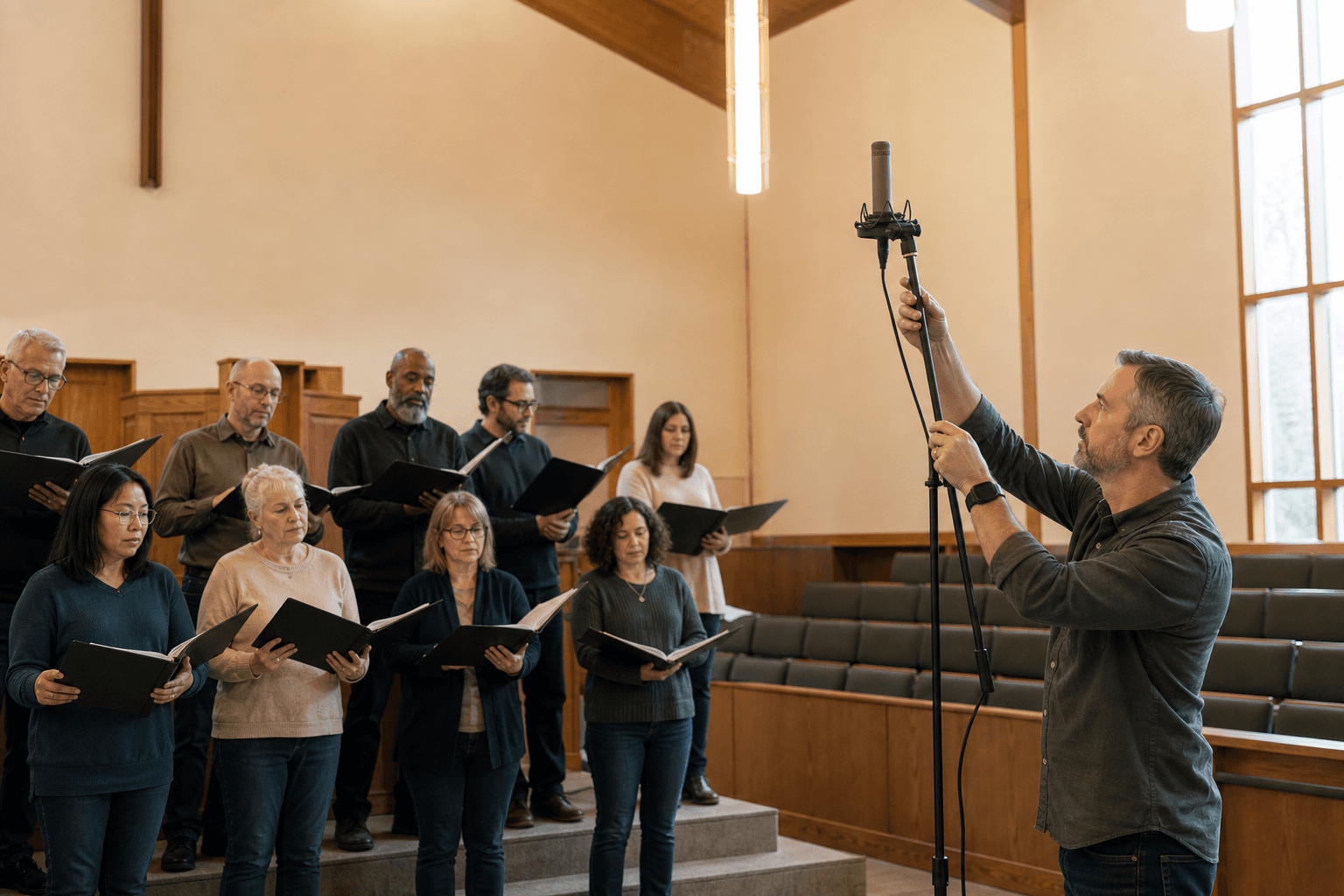
Choir pickup is a coverage problem shaped by distance, room acoustics, monitor spill, singer footprint, and loudspeaker geometry. This guide compares an accessible stand-mounted pair with purpose-built hanging options without pretending one microphone fits every choir.
The useful answer now
Use as few microphones as can evenly cover the choir, place them close enough to favour singers over the room, and keep them away from monitor and loudspeaker danger zones. A purpose-built hanging microphone may look tidier, while a stand-mounted pair can be easier to reposition and test.
Affiliate and editorial disclosure
This guide contains Amazon affiliate links. Voco may earn a commission at no extra cost to you. Picks are based on documented specifications, connection requirements, manufacturer evidence, and their fit for real church workflows; Voco has not hands-on tested every item. Exact listings are used only where product identity is unambiguous, otherwise the button opens an honest Amazon search. Prices, stock, marketplace ratings, and invented scores are deliberately omitted.
Start with the job
A stand-mounted pair is easier to move, measure, and remove. Safe cable routing and repeatable marked positions matter.
A hanging design can reduce visual clutter, but rigging, aiming, coverage, phantom power, and access for maintenance must be planned.
Monitor spill and gain-before-feedback can dominate the result. Microphone price cannot overcome poor geometry.
Quick comparison
Order follows the church decision path, not a laboratory score. “Best for” identifies the workflow each option most naturally fits.
| Option | Best fit | Tier | Connection notes | Editorial basis |
|---|---|---|---|---|
| Samson C02 matched pair | A low-cost stand-mounted choir pickup baseline | budget | Requires two mixer mic inputs with 48 V phantom power | Manufacturer documentation |
| Shure CVO | A purpose-built hanging choir microphone | mid-range | Requires 11–52 V phantom power | Manufacturer documentation |
| Earthworks C30 Gen 2 | A premium purpose-built choir pickup | premium | Professional balanced connection | Manufacturer documentation |
 Find on Amazon ↗
Option 1 · Samson
A low-cost stand-mounted choir pickup baseline
A cost-conscious stand-mounted pair for churches that want flexible choir placement rather than permanent hanging hardware.
Paid link · search fallback · listing/specification checked 2026-08-22
Manufacturer product image: Samson.
 Find on Amazon ↗
Option 2 · Shure
A purpose-built hanging choir microphone
A tidy permanent-installation option with aiming hardware and an attached long cable.
Paid link · search fallback · listing/specification checked 2026-08-22
Manufacturer product image: Shure.
 Find on Amazon ↗
Option 3 · Earthworks Audio
A premium purpose-built choir pickup
A premium low-visibility choice for permanent choir installations where placement access and coverage matter.
Paid link · search fallback · listing/specification checked 2026-08-22
Manufacturer product image: Earthworks Audio.
How to choose safely
Specifications narrow the field, but the room, mixer, local radio environment, clothing, volunteers, and recovery plan decide whether an option is right for your church.
See the Sunday checks →Buying guide
When multiple microphones cover one source, spacing them substantially farther apart than each microphone is from its nearest singers can reduce severe comb-filtering problems. The room still needs listening and measurement.
A choir microphone hears a three-dimensional area and the reflected room. Aim, distance, height, and loudspeaker position matter more than a neat coverage sketch.
Many choir condensers need phantom power. Check the mixer, cable run, strain relief, suspension hardware, and safe access before ordering.
Use the minimum that gives even coverage. More microphones can increase room sound, feedback risk, and phase interaction. Choir width, rows, room acoustics, placement distance, and monitor geometry determine the answer.
A close pastor microphone and a distant choir microphone solve different acoustic jobs. A choir needs area coverage; a pastor microphone is optimised for one nearby voice.
Hanging microphones can be discreet and repeatable in a permanent room. Stands are easier to move and compare. Sound quality depends on the capsule, placement, room, choir, and gain structure—not the mounting style alone.
Keep the equipment job separate
For a permanent church PA, begin with a region-correct UHF bodypack system. For portable livestream and camera work, a compact creator kit may be easier. Neither category is automatically better: the destination, local spectrum, recovery plan, and operator determine the right shortlist.
Open guide →Church buying guideA lapel works best for speakers who value low visibility and fairly consistent delivery. Highly dynamic preachers often get more consistent level and feedback margin from a well-fitted headworn microphone. If a lapel is still preferred, choose the system around the church mixer and test it on the pastor's normal clothing and movement.
Open guide →Church buying guideChoose an interface that accepts the actual level and connector from the church mixer, provides reliable monitoring, and reconnects cleanly after sleep, unplugging, or an app restart. Two inputs are enough for many churches; extra features only help when the volunteer workflow uses them.
Open guide →Church buying guideUse the church mixer feed for the main service whenever it provides a stable speech mix. Choose a compact wireless kit for mobile interviews, testimonies, phone video, or portable services, and insist on monitored routing plus a local backup recording.
Open guide →Church buying guideSpend first on a clean, monitored speech path. Reuse a stable pastor microphone and mixer when possible, add the correct cable or interface, label a spare, and rehearse recovery. Only replace the microphone after the current one fails a documented clarity, reliability, or compatibility test.
Open guide →Prove the signal before buying
A rehearsal makes the weak link visible. Monitor the actual computer input, test the pastor's normal voice, and only replace the component that fails.
Recommendations are editorial selections based on documented features and church-workflow fit; individual room and RF results vary. Affiliate disclosure · Church audio hub