Buying guide
Church translation for small churches — what it really costs in 2026
This page is for congregations under about 200 on a Sunday, where translation has to come out of a budget that already feels tight and be run by whoever is free that week. Most comparison pages in this category quote headline prices that bear little relation to what a church actually pays, because almost every tool meters something — hours, languages, connections, or credits that expire. Below is what each one costs, what the price actually includes, and an honest section on whether you need to buy anything at all yet.
The three things that decide your real bill
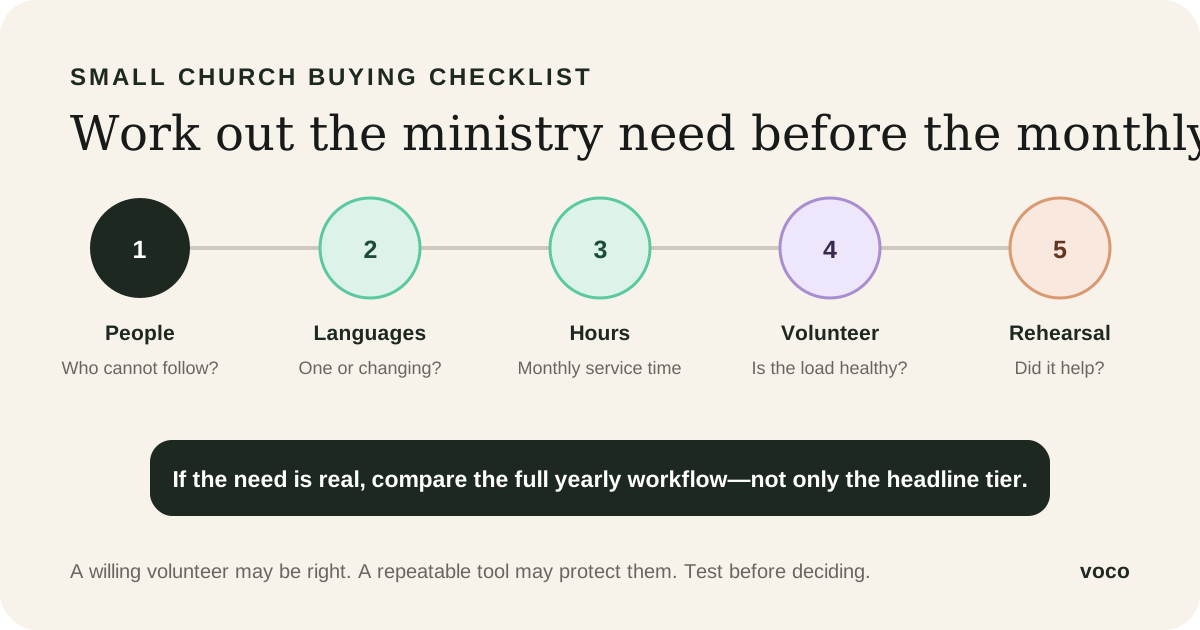
Headline price is the least useful number in this category. What determines what you actually pay is which of these a tool meters:
- Hours per month — most tools include somewhere between 1 and 30. A single 90-minute service is about 6 hours a month, so a 5-hour allowance covers roughly one weekly gathering and nothing else
- Languages — several tools include one language and charge for each additional one, or cap you at five. The languages that get cut are always the smallest groups, who have the fewest alternatives
- Attendees or connections — check custom quotes carefully for audience or connection limits, so adoption does not create an unexpected bill
Work out your hours before you compare anything
Take your weekly gatherings and multiply by 4.33. One 90-minute Sunday service is about 6.5 hours a month. Two services plus a midweek Bible study is roughly 18 to 20 hours. A monthly bilingual service is about 2 hours. That single number tells you more about which tool is cheapest for you than any feature table, because it determines whether you sit inside an included allowance or pay overage on top.
Be honest about whether you need this yet
If one bilingual member currently translates for two or three people and is happy doing it, you may not need to buy anything. Live translation earns its cost when the language group is large enough that a volunteer cannot cover it, when there are more languages than volunteers, when your interpreter is burning out, or when access disappears the week they are away. If none of those is true, spend the money elsewhere and revisit in six months. A tool nobody uses is worse value than no tool.
- One volunteer, one language, two or three people, and the volunteer is willing — you probably do not need a product yet
- One volunteer who has not sat with their own family in a service for a year — you have a problem, and it is a volunteer problem before it is a technology one
- More languages in the room than you have volunteers — this is the clearest case for a tool
- Access stops entirely when one person is on holiday — you need a fallback regardless of what else you do
Start with a free tier if you are unsure
Several tools offer useful free access before payment. Aurelo publishes an ongoing 2 hours a month with no card. Hope Translator publishes 30 minutes a month. Streamlingo currently offers a one-time 2-hour trial, Sunflower AI a full month of Basic, Breeze Translate a first service, and Voco 7 days with no card. If a permanent free tier is what you need, Aurelo or Hope Translator is the honest place to start.
What small churches should avoid
Two structures cause the most regret at this size:
- Anything requiring a sales call to learn the price. That model is built for denominational procurement, not for a treasurer trying to fill in a budget line this month
- Per-attendee or per-connection pricing, which penalises the thing you are trying to achieve — more people using it should not cost more
- Per-language charges if you have a long tail of small language groups, because the maths pushes you toward serving only the largest one
- Steep operator complexity. Whoever runs this will be a volunteer with ten minutes before the service starts, not an AV professional
Total cost is not just the subscription
Budget for a USB audio interface if you want good accuracy — something like a Focusrite Scarlett Solo or Behringer UM2 at roughly £50 to £120, taking a clean feed from your sound desk. This single purchase affects output quality more than the choice of tool, because every system transcribes before it translates and ambient room noise degrades that first step. Beyond that, budget an hour of volunteer time for a proper rehearsal and about ten minutes before each service. There is no per-device cost with browser-based tools, so attendee phones cost nothing.
Published prices for small churches, July 2026
| Tool | Starting price | Notes |
|---|---|---|
| Hope Translator | $20/mo | 5 hours included. Free 30 min/month ongoing. Cheapest paid entry we found. |
| Maestra | $79/mo | Real-time translation, billed annually. 180 translated minutes per language; captions-only starts at $39. |
| Kaleo AI | $24/mo | Starter tier. Mobile app required for translated audio. |
| VocoBest value | Starter £6/week or £24/month | Starter: one main weekly service. Church £12/week: around 5 live hours/week guidance and overlays. Pro £22/week: unlimited live hours. Unlimited attendees on every plan. |
| Breeze Translate | $8/week (~$35/mo) | First service free, no card. Nearly 200 output languages. |
| Sermon Live | $43/mo | Text-only, billed yearly. One language included; extras cost more. Audio tier is $127/mo. |
| Streamlingo | Dynamic checkout | Small plan advertised at about €10/hour annually. One-time 2-hour trial. Audio-first. |
| Aurelo | €49/mo | 10 hours included. Free 2 hours/month ongoing. Up to 40% off annually. |
| LiveSunday | $59/mo Pro | Or $5/hour pay-as-you-go. Wide integration set. |
| Sunflower AI | $90/mo | 7.5 hours, 1 room, 5 languages. Extra hours $40 each. Full free month to trial. |
| Glossa | $99/mo | Or $5/hour pay-as-you-go. OBS and ProPresenter on higher tiers only. |
| OneAccord | $150/mo | Starts with 5 hours. Final quote varies by languages, hours and users. Trained on biblical vocabulary. |
| spf.io | From $199/mo | Conference starting price; quote-based. Denominational packages also published annually. |
| Wordly | Quote only | Assessment-led pricing, no published self-serve tier. |
Frequently asked questions
Can a church of 50 people afford live translation?
Yes. Hope Translator starts at $20 a month, Voco at £6/week or £24/month, Aurelo offers 2 hours a month free, and Hope Translator offers 30 minutes a month free. For a monthly bilingual service a free tier may cover you entirely. For weekly use, budget roughly £24 to £35 a month at the low end plus a one-off £50 to £120 for a USB audio interface.
What is the cheapest church translation option?
On headline price, Hope Translator at $20/month for 5 hours is the cheapest paid tier we found, and Aurelo's free 2 hours a month is the cheapest option overall if your usage is genuinely light. For weekly use across several gatherings, compare the actual schedule with Voco Church or Pro; Voco Pro includes unlimited live hours, while Starter and Church use normal-use guidance.
Do we need a sound desk?
No, but it helps more than any other single decision. A laptop or phone microphone works for testing and proves the workflow. For live services, a clean feed from your mixing board through a USB audio interface costing £50 to £120 improves transcription accuracy substantially, and everything downstream depends on that first step being right.
Can one volunteer run this?
Yes, with any of the browser-based tools. The realistic workload is about ten minutes before the service — start the session, check the QR code is on screen, confirm one translated line reads correctly on a second phone. Budget an hour once for a proper rehearsal before the first live use, and make sure at least two people know how to start it so access does not depend on one person being present.
How many languages will we actually need?
Most small churches need one or two to start, which is why per-language pricing looks affordable at first. It becomes a problem as word spreads and smaller groups appear — one Tigrinya family, two Twi speakers, a Farsi speaker who arrived last month. If you expect a long tail, choose a tool that includes all languages rather than one that charges per language.
Is it worth it if only a few people use it?
That depends on who those people are. Three people who currently understand nothing of the sermon is a different situation from three people who follow along adequately in English. Translation is usually judged on whether it changes someone's ability to participate at all, not on headcount. That said, if a willing volunteer already covers the need well, spending the money elsewhere is a reasonable decision.
Related comparisons
Cheapest Church Translation Software (2026) — Full Price Comparison
Every live church translation tool compared by price. Honest, verified pricing f…
Voco vs Hope Translator for Churches (2026): Honest Comparison
An honest comparison of Voco and Hope Translator for live church translation — u…
Voco vs Aurelo for Church Translation (2026): Honest Comparison
An honest comparison of Voco and Aurelo for live church translation — hourly pla…
Try it yourself
Free for 7 days — no credit card
Guided setup helps you rehearse before Sunday. Cancel any time.
Start free trial