Pentecostal church guide
Pentecostal church translation for spontaneous, live worship
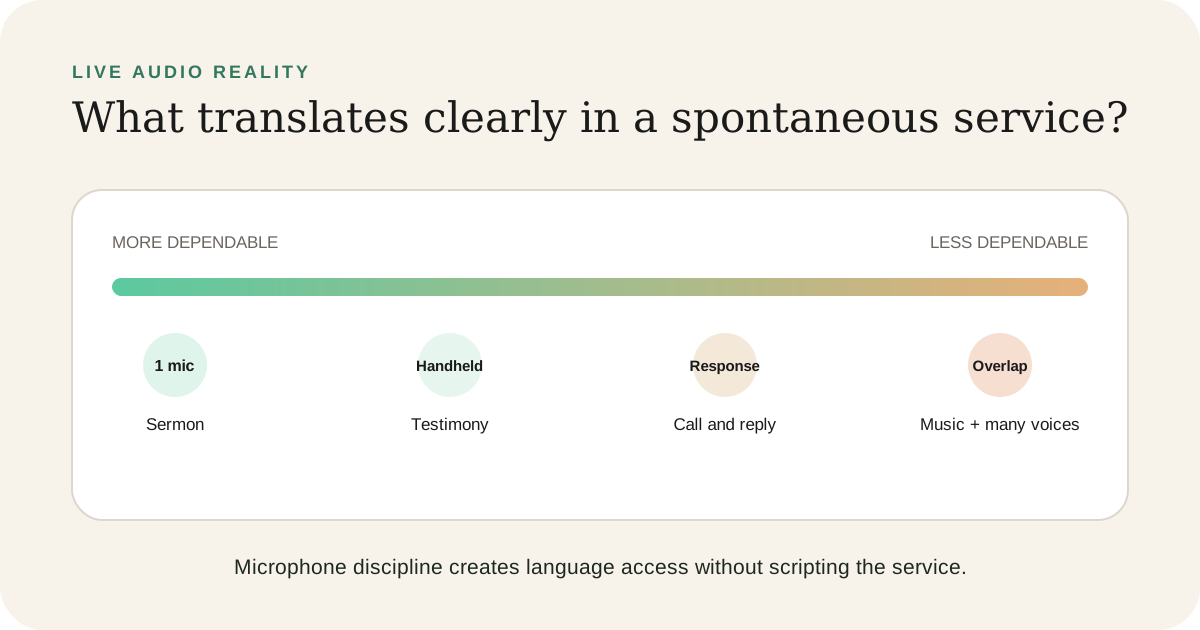
Pentecostal services create a demanding live-audio environment: a planned sermon may sit beside spontaneous prayer, testimony, call-and-response, music, and rapid changes of speaker. Translation must serve that worship honestly without pretending overlapping voices are clean speech.

By Josh Stannard, Founder of Voco
Building practical live translation for churches. Updated August 2026.
Plan for freedom without promising impossible audio
Spontaneity does not mean the AV team has no plan. Decide which microphones feed translation, who hands a microphone to a testimony, and what the operator should do when the room moves into overlapping prayer or song.
Assemblies of God guidance describes Pentecostal worship as planned and integrated while leaving room for spontaneous work of the Spirit. The practical translation equivalent is a prepared audio pathway with flexible expectations: keep translating a clear leader; pause or accept partial text when many people speak; resume when a single voice returns.
That is more honest than displaying confident nonsense during the loudest moment of the service.
Make every important speaker audible at the sound desk
The system cannot translate a testimony it cannot hear. Route the pastor’s headset, lectern, handheld, and testimony microphones to a dedicated auxiliary or matrix output.
Avoid feeding a full music mix if a speech-only bus is available. Train ushers or platform leaders to bring a microphone before someone begins a public testimony.
When a speaker is praying from the floor without amplification, the human congregation may understand through proximity and context while the laptop receives only reverberation. Treat that as an audio-access issue, not an AI failure.
- Use one close microphone for each led spoken moment
- Prefer a speech-focused auxiliary feed over the full front-of-house mix
- Keep handheld microphones ready for testimony and interpretation
- Do not promise accurate translation of simultaneous congregational prayer
Protect the meaning of prayer, prophecy, and response
Fast, figurative, emotionally intense speech is difficult to translate well, particularly when phrases are unfinished or the congregation replies over the leader. Give fluent reviewers examples from the real church, not only a calm teaching clip.
Add pastor names, local ministries, recurring biblical phrases, and theological vocabulary to the glossary. For a prophetic message, safeguarding direction, healing testimony, or personal ministry, keep accountable human leadership and interpretation in place.
A translated screen can help someone follow the public moment, but it cannot authenticate a message, carry pastoral responsibility, or manage consent.
Help attendees keep up without changing the room
A visitor scans one QR code and chooses from 200+ output languages on their own phone. They can enlarge the text and remain with family rather than sitting beside a receiver station.
Start the session during the welcome, because late access during a fast transition is frustrating. Put the code on foyer signage and a persistent corner of the projection when appropriate.
During the sermon, allow natural sentence boundaries rather than asking the preacher to slow unnaturally. Translation timing will vary; the aim is understandable participation, not dubbing every syllable in perfect synchrony.
Treat music and tongues with theological and technical honesty
Speech recognition is not lyric transcription, and live translation is not an interpretation of glossolalia. Provide song lyrics and any planned multilingual refrain through the church’s normal projection system.
During congregational singing, either pause the live feed or let readers know that sermon translation resumes afterwards. If an utterance in tongues is followed by an interpretation spoken clearly into a microphone, the system can translate the spoken interpretation as ordinary speech; it should never claim to derive an interpretation from the utterance itself.
This boundary protects both technical credibility and Pentecostal theology.
Review spiritual language with people from the community
A technically grammatical sentence can still sound pastorally strange. Ask trusted speakers of each target language to review examples of prayer, invitation, testimony, healing language, and biblical imagery.
Record the preferred vocabulary in the glossary and explain that feedback is about access, not policing a preacher’s style. Where the church serves several cultures that share a language, do not assume one reviewer represents them all.
Review again when a guest speaker, regional variety, or substantially different ministry setting changes the language being used.
Run a realistic Pentecostal pilot
Use the 7-day no-card trial for three different recordings: a sermon, a testimony, and a prayer/response section. Score each separately.
The sermon may be ready while overlapping prayer is not—and that can still be a worthwhile ministry outcome. Then rehearse with the actual sound-desk bus and two target-language reviewers.
Voco Starter begins at £6/week for one main service; churches running several services, youth gatherings, or streamed overlays should compare the Church plan at £12/week. Buy only after volunteers can repeat the setup without the founder in the room.
Frequently asked questions
Can Voco translate spontaneous prayer?
It can translate one clear amplified speaker. Accuracy will fall when several people pray at once, music is loud, sentences are unfinished, or the speaker is off microphone. Test your church’s real prayer environment.
Will it translate speaking in tongues?
Voco should not be used or described as interpreting glossolalia. If a person subsequently gives an interpretation in an ordinary spoken language through a microphone, that spoken interpretation can be transcribed and translated like other speech.
What about call-and-response preaching?
The preacher’s close microphone can remain intelligible, but loud overlapping congregation responses may interrupt the transcript. A speech-focused audio feed and realistic rehearsal are essential.
Can attendees hear the translation?
The core output is text. Compatible phones may read text using their built-in voice, but voice availability and quality vary by device and language. Voco does not currently clone the preacher’s voice.
Can we use it for youth night as well as Sunday?
Yes, depending on the plan and weekly usage. Test youth-night audio separately because room noise, handheld microphones, games, and music may produce a different result from Sunday preaching.
Primary references
Official denominational resources used to verify the service-specific guidance on this page.