2026-08-25 · 8 min read
Reaching Spanish-Speaking Families: A Guide for English-Speaking Churches
Hispanic ministry without a Spanish-speaking pastor, what actually works, what quietly fails, and why language is a matter of belonging, not just comprehension.
By Josh Stannard, founder of Voco
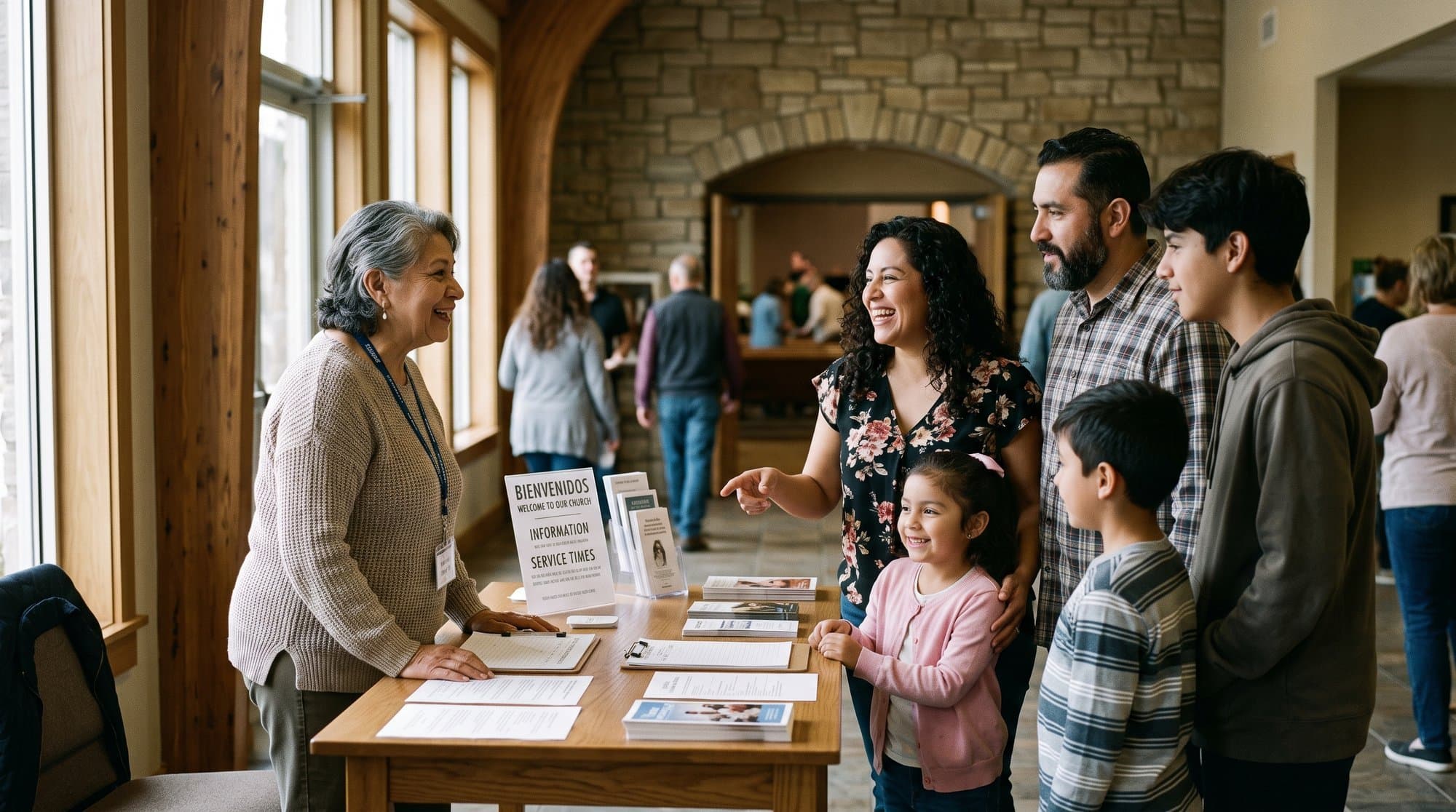
Spanish is, by a wide margin, the language most often requested for church translation, whichever side of the Atlantic you're on. This guide is for the English-speaking church, in the UK or anywhere else, that's noticed Spanish-speaking families in its midst or its neighbourhood and wants to reach them well, without a Spanish-speaking pastor and without pretending to be something you're not.
The scale
The most detailed data on Hispanic Christian identity comes from the US, where Pew Research's 2023-24 Religious Landscape Study tracked a real shift: the share of US Hispanic adults identifying as Catholic fell from 67% in 2010 to 42% in 2024, while the religiously unaffiliated share rose from 10% to 27% over the same period, and Evangelical Protestant identification held relatively steady at around 17%. It's worth being honest that this is US-specific data, the UK's Latin American and Spanish-speaking population is smaller and shaped by different migration patterns, but the underlying trend it points to matters wherever you are: Spanish-speaking communities are not a single, static religious bloc. Some families come from strongly practising Catholic backgrounds, some are actively exploring Evangelical or Pentecostal churches, and a growing number identify with no religious tradition at all while still valuing being welcomed by one.
Don't assume you know where a Spanish-speaking family sits on that spectrum before you've asked. The Catholic-by-default assumption, still common in a lot of outreach material, increasingly doesn't match reality.
In the UK specifically, the Spanish-speaking and wider Latin American population is smaller than in the US and shaped by different migration patterns, drawing from Spain itself, and from Colombia, Ecuador, Peru, Venezuela and other Latin American countries, often concentrated in specific London boroughs and a handful of other UK cities. The community is genuinely diverse in country of origin, immigration status, and length of time in the UK, and the same caution about assuming a shared religious profile applies here just as much as it does in the US context. What holds across both is the underlying pastoral reality: whatever a family's starting point, most are navigating it in a language that isn't their church's, or their new country's, first language.
Why "we're friendly" isn't enough
Warmth is necessary and nowhere near sufficient. A Spanish-speaking family can feel genuinely liked and still feel completely outside the actual life of a church, if every sermon, every announcement, every small group conversation happens in a language they're following at maybe 60% comprehension.
That gap compounds quietly. Missing the nuance of a sermon means missing the thing the sermon was actually about. Not catching an announcement means finding out about the potluck after it happened. None of it is anyone's fault, but the cumulative effect is a family that's present but never quite inside the community. Language access isn't a nice add-on to belonging, it's most of the mechanism by which belonging happens at all.
There's also a specific version of this that shows up in Hispanic ministry more than most: a family that's fully fluent in spoken, conversational English, enough to chat comfortably at coffee hour, but still finds a 30-minute sermon delivered at native speaking speed a genuinely different comprehension task. Conversational fluency and sermon-level comprehension are not the same skill, and a church that assumes "they speak English fine" from a friendly chat at the door can miss that a family is still working hard, every single week, just to follow the main event.
Five things that work
A genuinely bilingual welcome, not just a translated sign. A greeting in Spanish, delivered by someone who's put in the (often imperfect) effort to learn it, signals more than any printed material.
Live Spanish captions or audio during the service. For churches without a bilingual pastor or a sustainable volunteer interpreter roster, live translation software that puts captions on a family's own phone via a QR code, no app, no headset queue, lets people follow the sermon in Spanish from their very first Sunday.
Family-oriented events, not just Sunday services. Many Spanish-speaking cultures place strong emphasis on extended family and multigenerational gathering. A church event that welcomes grandparents, cousins and children together, rather than splitting everyone into age-segmented programmes, often lands better than a typical youth-group or adults-only format.
Partnership with an existing Hispanic church, rather than competing with one. In many towns and cities there's already a Spanish-language congregation doing this well. Joint events, shared resources, or simply a warm referral relationship serves families better than an English church trying to build Hispanic ministry from scratch in isolation.
Raising leaders from within the community, not just serving it. The families you're reaching are not a permanent mission project, many will grow into people who lead worship, teach, or serve on staff, if given the chance rather than kept in a "ministry recipient" role indefinitely.
None of these five require choosing between them. Many churches that reach Spanish-speaking families well end up running several simultaneously, live translation covers the Sunday sermon while a monthly family event builds relationship outside it, and a partnership with a nearby Hispanic congregation means neither church has to be everything to everyone.
Culture notes an English church should know
A few patterns show up often enough to be worth naming, held loosely, because "many families" is accurate and "all families" never is.
Personal warmth and physical presence, greetings, hugs, unhurried conversation before and after a service, often matter as much as programme content. A church that rushes people out the door after the closing song can feel colder than intended.
Extended family involvement in big decisions, including spiritual ones, is common. A conversation about baptism or membership that only involves one person, rather than acknowledging the wider family's view, can misread the situation.
Formality and informality both show up in unexpected places, some families expect more traditional reverence in worship style than a casual English evangelical service offers; others are used to considerably more expressive, participatory worship than a quieter English congregation is used to. Ask rather than assume either direction.
Food and hospitality often carry more weight than an English church might expect from a coffee-and-biscuits after-service routine. Being invited into someone's home, or invited to bring a dish that matters to a family rather than a generic "bring a plate" request, can move a relationship forward faster than several formal welcome conversations. This isn't a rule so much as a general tendency worth being aware of and responsive to.
Case pattern: growing a Spanish congregation from a handful of families
A pattern documented across a number of churches that have built sustained Hispanic ministry looks something like this: it starts small, four or five families, often connected through work, school, or a single well-placed relationship. Rather than launching a full separate Spanish-language service immediately, the church begins with something lighter, a monthly bilingual gathering, a Spanish-language small group, translated materials for the existing service. Only once there's a critical mass, and clear demand from the families themselves, does a dedicated Spanish-language service or track become the right next step, usually built with leadership drawn from within that original small group rather than imported from outside.
The pattern I have seen is people finding each other first. A few Spanish speakers from different churches realise they are all in the same city, and somebody suggests getting together to worship in their own language. It is not a church plant. It is a handful of people who want to sing in their mother tongue.
From there it grows on its own. Somebody notices there are Portuguese speakers too, so a Portuguese home group starts. Then perhaps a Portuguese worship night. You start where you actually are, with the people already in front of you, and let it become whatever it becomes.
What's consistent across the pattern, even without a specific named example, is that the growth rarely comes from a single big programme launch. It comes from a series of small, repeated decisions, translating this one thing this week, hosting this one gathering this month, that compound over a year or two into something that looks, in retrospect, like a deliberate strategy. Few churches that end up with a thriving Spanish-speaking congregation set out with that exact plan from day one.
A word on assumptions worth dropping
A handful of assumptions quietly shape a lot of well-meaning Hispanic outreach, worth naming so they can be dropped deliberately rather than carried unexamined. That every Spanish-speaking family is recently arrived, when many have been in the country for a decade or more and simply prefer Spanish at home and church regardless of fluency elsewhere. That Spanish is a single, uniform language experience, when Mexican, Colombian, Spanish and Argentinian Spanish, among many others, carry real differences in vocabulary and accent that a translation tool or a bilingual volunteer needs to be aware exists. And that reaching Spanish-speaking families is primarily a translation problem, when translation is necessary but the deeper work, as with any community, is relationship, patience, and a genuine willingness to be changed by who you're welcoming.
Where to start this Sunday
If you're not ready to commit to a dedicated Spanish-language service, the lowest-friction starting point is language access during your existing service. It costs nothing to try for a single Sunday, requires no app for anyone to install beforehand, and gives you a genuine sense of how much demand actually exists before committing to anything larger. Voco supports Spanish translation via QR code, no app required (voco.church/translate/spanish), and there's a dedicated setup guide for Spanish specifically at voco.church/spanish-church-translation.
Full disclosure: I built Voco, one of the tools mentioned here.
Frequently asked questions
What should churches know about the scale?
The most detailed data on Hispanic Christian identity comes from the US, where Pew Research's 2023-24 Religious Landscape Study tracked a real shift: the share of US Hispanic adults identifying as Catholic fell from 67% in 2010 to 42% in 2024, while the religiously unaffiliated share rose from 10% to 27% over the same period, and Evangelical Protestant identification held relatively steady at around 17%. It's worth being honest that this is US-specific data, the UK's Latin American and Spanish-s
What should churches know about why "we're friendly" isn't enough?
Warmth is necessary and nowhere near sufficient. A Spanish-speaking family can feel genuinely liked and still feel completely outside the actual life of a church, if every sermon, every announcement, every small group conversation happens in a language they're following at maybe 60% comprehension.
What should churches know about five things that work?
A genuinely bilingual welcome, not just a translated sign. A greeting in Spanish, delivered by someone who's put in the (often imperfect) effort to learn it, signals more than any printed material.
What should churches know about culture notes an english church should know?
A few patterns show up often enough to be worth naming, held loosely, because "many families" is accurate and "all families" never is.
First published on Medium.