2026-09-21 · 7 min read
Live Spanish Captions for Church: Three Ways to Do It This Sunday
Your Spanish-speaking families shouldn't have to wait for a hired interpreter, three real setups compared, so you can pick one before Sunday.
By Josh Stannard, founder of Voco
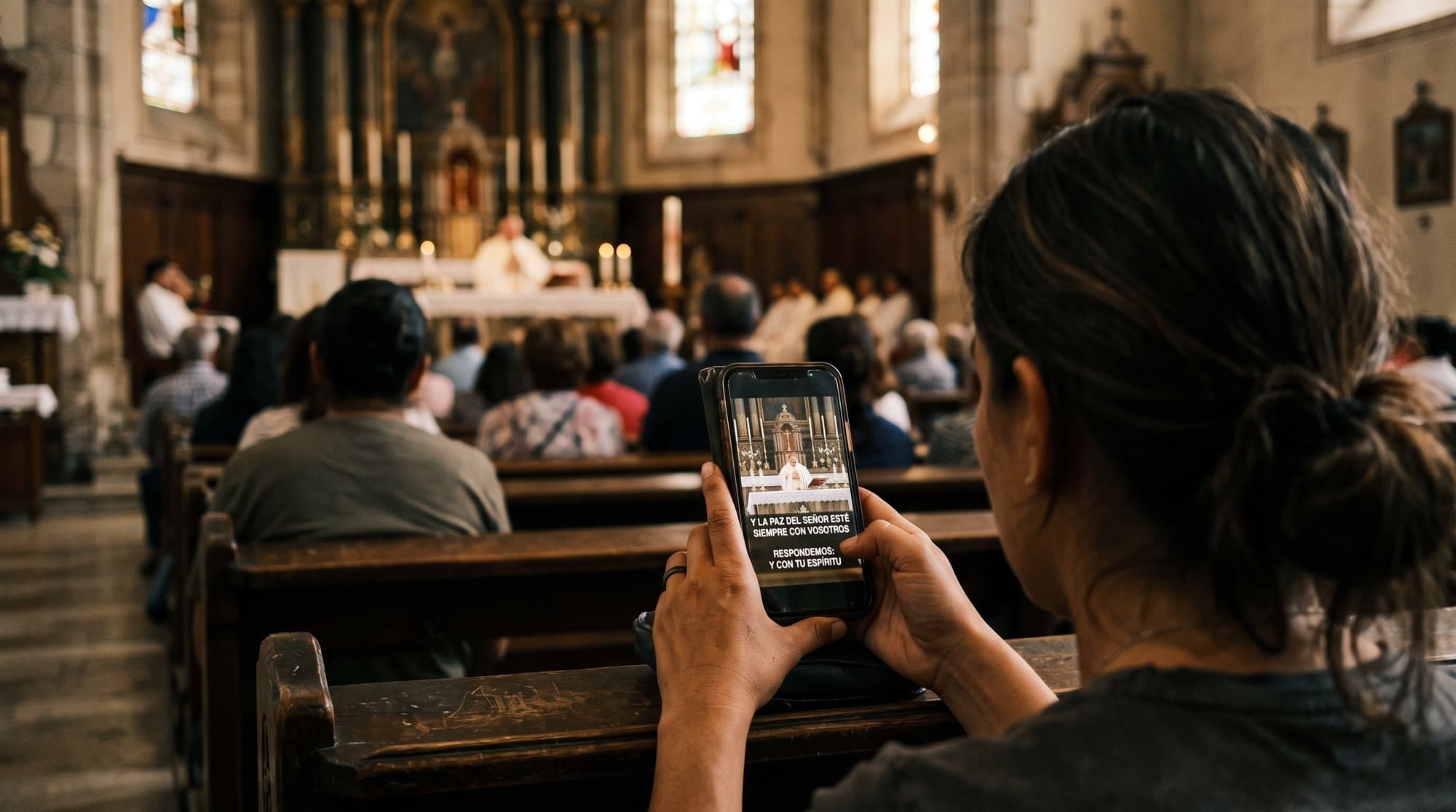
Spanish is, by a wide margin, the language request that comes up first when a church starts thinking about translation. If you're a pastor or volunteer trying to work out how to serve Spanish-speaking families this Sunday, not in six months, this Sunday, here are three real ways to do it, what each one actually costs, and which one to reach for depending on your church's size and budget.
Why Spanish is the number one request
In the US, Hispanic Christians make up a large and growing share of many congregations, and language remains a live, practical issue inside churches that serve them, not just a demographic footnote. Pew Research's 2023-24 Religious Landscape Study found that among Hispanic Catholics specifically, 38% say they usually attend Mass in Spanish and another 23% do so sometimes, with Spanish-language attendance notably more common in the South and West than the Northeast or Midwest (Pew Research Center, "US Catholics' views of their local parish," 2025). That's not a fringe accommodation, it's the primary worship language for a substantial share of one of the largest Christian demographic groups in the country.
In the UK, the picture is smaller in absolute numbers but the same in shape: Spanish-speaking congregations and Spanish-language services have grown steadily in cities with established Latin American communities, and churches without any Spanish provision often discover the need only after a family has already tried, and failed, to follow a service they couldn't understand.
Whichever side of the Atlantic you're on, the pattern is consistent: Spanish-speaking families are far more likely to keep attending a church that's made some real effort to include them in their own language, even an imperfect one, than a church that's made none.
There's a second reason Spanish tends to come first, beyond sheer numbers: it's usually the language a church already has at least one fluent volunteer for, even before anyone's planned for it formally. That existing fluency is an asset worth building on rather than sidelining once you introduce software or a formal process, a bilingual volunteer checking captions for accuracy in the early weeks catches errors a purely automated setup would miss.
Option 1: volunteer + Google Translate
The most common starting point, because it costs nothing and needs no setup. A bilingual congregation member sits with a Spanish-speaking visitor and either whispers a live translation or types key points into a translation app for them to read.
What it actually looks like: works reasonably well for one or two visitors on an occasional Sunday. Breaks down fast with more than a handful of people needing it, because it depends entirely on one volunteer's availability, stamina, and fluency, and general-purpose translation apps aren't tuned for theological vocabulary, so phrases like "sanctified" or "the Beatitudes" often come out garbled or literal in ways that lose the meaning.
Cost: free. Fragility: high. One sick volunteer and the whole provision disappears for the week.
A note on whispered live translation specifically: it works, and it's genuinely warm, a real person sitting beside a visitor, in real time, is hard to beat for personal connection. The limits show up with numbers. One volunteer can whisper-translate for one, maybe two people comfortably. Beyond that, either you need more volunteers than most churches have on hand, or the people further from that volunteer simply don't get served.
Option 2: captioning platforms
Dedicated live captioning services (in the spf.io mould) transcribe spoken English in real time and can often push a translated version to a screen or personal device. These are built primarily for accessibility captioning first, with translation as an add-on feature.
What it actually looks like: solid accuracy for the English transcription itself; translation quality varies by provider and is sometimes a secondary feature rather than the core product. Setup typically needs a dedicated account, sometimes a subscription tier above the basic captioning plan, and occasionally a screen display rather than a personal-device QR flow.
Cost: varies widely by provider, generally landing in a mid-range monthly subscription bracket once translation is added on top of base captioning. Fragility: low once set up, but the setup itself is often more involved than option 3, and not every plan includes Spanish as a translation target by default, check before you commit.
Worth knowing: these platforms are often the right call if you're already running captions for deaf or hard-of-hearing members of your congregation, since Spanish translation can sometimes be layered onto infrastructure you've already built and paid for. If you're starting entirely from scratch purely for Spanish, the setup overhead may not be worth it compared to option 3.
Option 3: QR-code live translation
A phone or laptop mic feeds a translation engine tuned for spoken speech, and the congregation reads live Spanish captions on their own phone by scanning a QR code, no app install, no headset collection at the end of the service.
What it actually looks like: this is Voco's lane specifically. Full disclosure: I built Voco, the tool used in this walkthrough. It's built around church vocabulary rather than general business speech, so theological terms translate more sensibly than a general-purpose tool, and it covers Spanish alongside 50+ other languages from the same setup, useful if your Spanish-speaking family this week is followed by a Portuguese-speaking one next month. There's a 7-day free trial with full access and no card required, so you can genuinely test it on a real Sunday before deciding.
Cost: £6/week on the Starter plan, £12/week on the Church plan (plus VAT), depending on features needed. Fragility: low, provided the audio feed into the software is clean, see the live Spanish captions guide for the setup details, and the Spanish translation page for language-specific notes.
The Sunday-ready comparison
| Option | Setup time | Cost | Reliability | Best for |
|---|---|---|---|---|
| Volunteer + Google Translate | Minutes | Free | Low, depends on one person | 1-2 visitors, occasional need |
| Captioning platform | Hours to days | Mid-range monthly subscription | Good once configured | Churches already using captioning for accessibility |
| QR-code live translation | Under an hour | £6-12/week + VAT | Good, if audio feed is clean | Growing Spanish-speaking attendance, multiple languages needed |
In short:
- If you're dealing with one visitor on one Sunday, the free volunteer route is genuinely fine.
- If you already run captioning for accessibility, adding Spanish translation to that same platform may be the path of least resistance.
- If Spanish-speaking attendance is growing, or you expect to need more languages down the line, QR-code live translation scales without adding cost per extra language, and the free trial removes the risk of committing before testing it live.
Getting Option 3 running this Sunday
The person following along on their phone doesn't download anything; they scan and read.
One more thing worth knowing. Once the setup exists for Spanish, adding a second or third language the following month is the same process, not a new project, worth knowing if your Spanish-speaking family this Sunday is the leading edge of a wider shift in who's walking through the door. Voco also maintains a directory of churches offering Spanish translation, useful both for finding a nearby example to visit and for Spanish-speaking families looking for a church that's already set up to include them.
Spanish-speaking families don't need a perfect solution on the first Sunday. They need a church that visibly tried something rather than assuming the problem would sort itself out. Any of the three options above beats doing nothing, pick the one that fits this Sunday, and refine from there.
One more thing worth saying plainly: whichever option you choose, tell the family or visitor directly that it exists. A QR code on a screen that nobody points out, or a translation option buried in a footnote of the bulletin, doesn't get used even when it's genuinely available. The single highest-impact thing a greeter can do for a Spanish-speaking visitor is simply explain, in their own language if possible, that there's a way to follow along, and show them how, rather than leaving them to discover it alone.
Frequently asked questions
What should churches know about why spanish is the number one request?
In the US, Hispanic Christians make up a large and growing share of many congregations, and language remains a live, practical issue inside churches that serve them, not just a demographic footnote. Pew Research's 2023-24 Religious Landscape Study found that among Hispanic Catholics specifically, 38% say they usually attend Mass in Spanish and another 23% do so sometimes, with Spanish-language attendance notably more common in the South and West than the Northeast or Midwest (Pew Research Center
What should churches know about option 1: volunteer + google translate?
The most common starting point, because it costs nothing and needs no setup. A bilingual congregation member sits with a Spanish-speaking visitor and either whispers a live translation or types key points into a translation app for them to read.
What should churches know about option 2: captioning platforms?
Dedicated live captioning services (in the spf.io mould) transcribe spoken English in real time and can often push a translated version to a screen or personal device. These are built primarily for accessibility captioning first, with translation as an add-on feature.
What should churches know about option 3: qr-code live translation?
A phone or laptop mic feeds a translation engine tuned for spoken speech, and the congregation reads live Spanish captions on their own phone by scanning a QR code, no app install, no headset collection at the end of the service.
First published on Medium.