2026-08-25 · 7 min read
Human Interpreter vs AI Translation for Church: The Real Cost Breakdown
Fifty pounds to two hundred and fifty pounds a Sunday for a human interpreter, or six to twelve pounds a week for AI. Here's where each one actually wins.
By Josh Stannard, founder of Voco
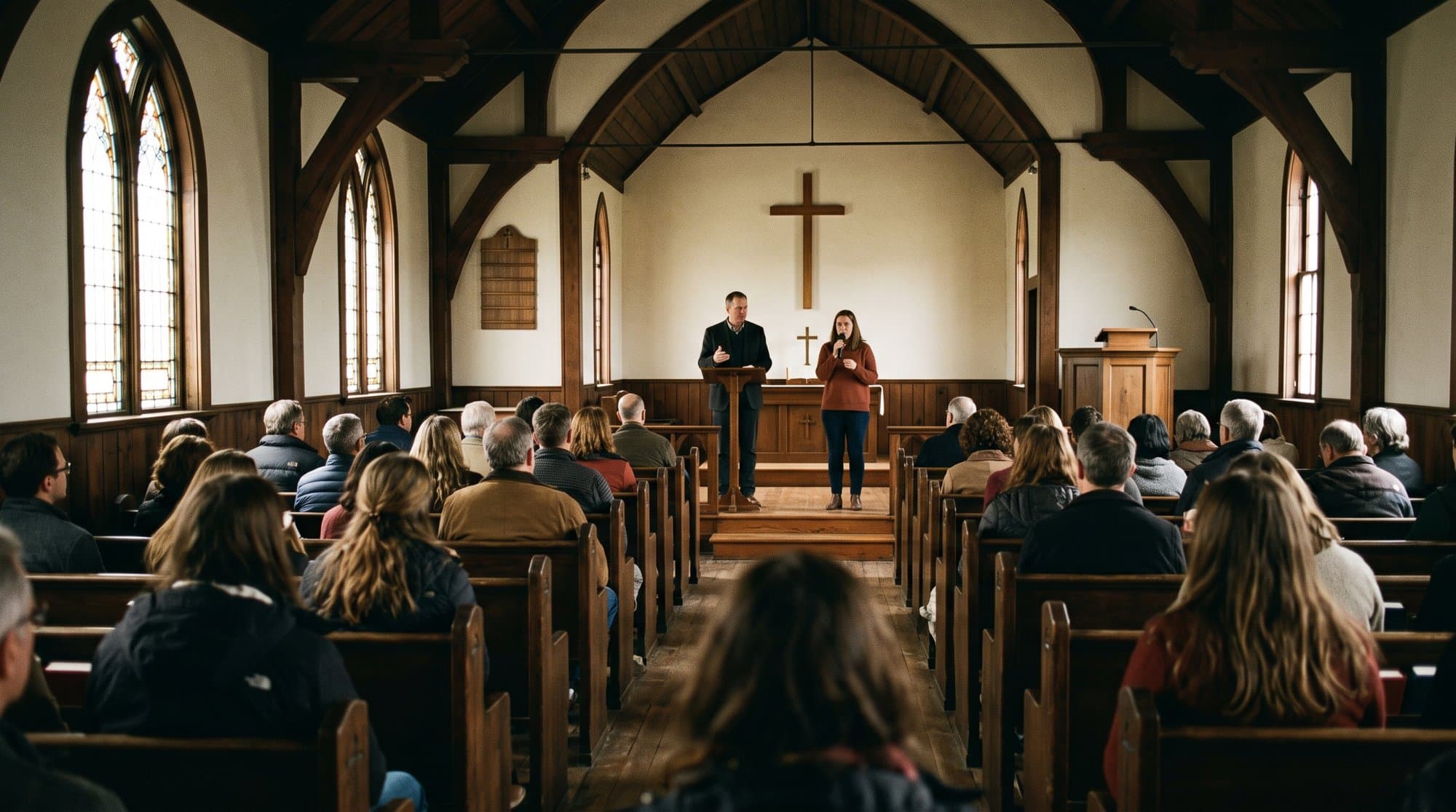
Somewhere in most multilingual churches there's a person, usually a member, sometimes a staff member, standing a few feet from the pulpit with a small microphone, translating a sermon they've never seen a script of, in real time, for free or close to it. It's one of the most quietly heroic jobs in a church and almost nobody thanks them properly for it.
This article is not an argument for replacing that person. It's an honest look at what they cost, what they're worth, what AI translation actually costs and can and can't do, and where the two fit together, because for most churches the answer isn't "either/or." It's "our interpreter for the languages we have one for, and something else for the nine we don't."
Full disclosure: I built Voco, one of the AI tools in this comparison. I've tried to be fair to interpreters throughout, because they deserve it. Prices checked August 2026.
What a human interpreter really costs
A professional freelance interpreter in the UK charges roughly £45/hour as a national median (cited by the Diocese of London's guidance for churches), though almost every interpreter has a minimum call-out fee equivalent to two or three hours regardless of actual time worked. Rough published guides put a half-day (up to 3.5 hours) at around £170 and a full day at £320, plus travel and VAT. BSL interpreters run higher still: expect at least £185 for a 1-3 hour booking, and two interpreters (not one) for any session over 45 minutes, because simultaneous interpreting is genuinely exhausting cognitive work and quality drops fast without rotation.
For a weekly Sunday service, that's £8,800-£17,700 a year for one language, if you're paying market rate. Many churches don't pay market rate. They rely on a bilingual volunteer instead, and the real cost there isn't money, it's:
- Burnout. Live interpreting for 30-40 minutes straight is one of the most mentally demanding things a person can do. Volunteers doing it weekly, unpaid, untrained, are prone to fatigue and eventually stop.
- Availability. One person means one point of failure. They're on holiday, they're ill, they've had a baby, and suddenly there's no translation that week.
- They never get to just be in the service. The person interpreting is working the entire time. They don't get to worship, they don't get to simply receive what's being preached. That's a real cost, even if it never appears on a spreadsheet.
- It scales to about two languages, maybe three, before it becomes unmanageable. Most churches with growing diversity end up needing five, eight, twelve languages within a few years of active outreach. You can't recruit a volunteer interpreter for every one of them.
None of that is an argument against human interpreters. It's an argument for not asking one person to be your entire multilingual strategy. Voco has a longer breakdown of this exact comparison if you want to go deeper on the numbers.
What AI translation really costs, and what it can't do
AI subscription software built for churches runs, in 2026, somewhere between free (Google Translate, with real limitations) and about £12/week for a purpose-built church tool. Voco's own pricing is £6/week for the Starter plan or £12/week for the Church plan, plus VAT, with a 7-day free trial with no card needed. Annualised, that's £312-£624 a year. Translation is available in 200+ attendee languages; Starter allows 1-2 language groups per service, while Church makes all supported languages available simultaneously.
That's the cost side. The accuracy side needs honesty, because this is where most vendor content goes quiet.
AI speech translation genuinely struggles with:
- Theological vocabulary. Words like "justification," "sanctification," or "the flesh" carry meanings in a sermon that differ from everyday usage. A model trained on general internet text can translate "the flesh" as literal meat rather than sinful human nature, unless the vendor has specifically trained around it. This is a real, documented failure mode, not a hypothetical one.
- Emotion and delivery. A pastor's voice rises, falls, pauses, sometimes breaks. Machine translation, especially anything routed through text-to-speech, tends to flatten that into something emotionally neutral. Software doesn't weep with the room.
- Culture and idiom. A joke about a local sports team or a cultural reference translates literally and lands as confusion, not humour. A human interpreter adapts on the fly. Software mostly doesn't.
- Audio quality is the single biggest lever. Background noise, mumbling, a bad mic, someone speaking too fast: these degrade AI accuracy fast, more than most churches expect. Get the audio chain right and accuracy improves enormously; skip it and results will disappoint.
Voco's approach to the vocabulary problem specifically is boosted theological vocabulary in the recognition layer, which helps with the "flesh" problem above, but it doesn't solve emotion or cultural nuance, and no AI tool honestly can yet. If your service leans heavily on wordplay, local references, or long unscripted pastoral asides, expect the software to do a passable job on comprehension and a poor job on feeling.
Head-to-head: cost, accuracy, warmth, scale
| Factor | Human interpreter | AI translation |
|---|---|---|
| Annual cost (1 language, weekly) | £8,800-£17,700 | £312-£624 |
| Number of languages realistically covered | 1-3 before volunteer burnout | 50+ simultaneously |
| Theological/doctrinal precision | High, with training | Improving, but genuine gaps remain |
| Emotional/tonal accuracy | High | Low to moderate |
| Availability | Depends on one person's schedule | Always on |
| Setup effort | Recruit, train, schedule | Minutes, per service |
- Cost gap between the two is roughly 20-40x for a single language, in the human interpreter's favour of expense and the AI's favour of budget.
- A human interpreter tops out at the languages you can recruit for; AI tops out at the languages the model supports (50+, in Voco's case).
- Neither one wins on every axis, which is the actual point.
There's a fuller worked-example version of this table, with more church sizes, in this cost comparison resource.
The hybrid answer most churches land on
The honest pattern I've seen described repeatedly, and the one that makes the most sense on paper: keep your human interpreter for the one or two languages where you have a gifted, willing volunteer or a budget for a professional, especially for anything doctrinally weighty or emotionally significant, weddings, funerals, baptism testimonies. Then use AI translation for everything else. The nine languages you don't have an interpreter for. The visiting family who shows up once and speaks a language nobody on your team knows. The Tuesday night event where your usual interpreter can't make it.
AI doesn't replace your interpreter. It covers the languages you don't have one for.
My parents' church had a volunteer who could translate into Farsi, and she was brilliant. She ended up serving a couple of churches over the years, theirs and later one of ours. When she was away, that was simply it. And when a Spanish speaker turned up, the answer was to go and find me and Maha.
We have sat with a family from El Salvador who were piecing the service together out of the English they could catch, with the two of us filling in what we could as it went. They were in the room the whole time. That is not the same thing as being able to follow it.
There is something very personal about hearing it in your own language. Not a summary afterwards, not the gist of it. The same thing everyone else is getting, at the same time. It is the same gap when there is nobody to sign, and the person who needed it quietly misses out.
That's genuinely why I built Voco the way I did: not as a replacement for the person standing next to the pulpit, but as the thing that catches everyone that person can't reach. See how the QR-code setup actually works on a Sunday.
Frequently asked questions
What should churches know about what a human interpreter really costs?
A professional freelance interpreter in the UK charges roughly £45/hour as a national median (cited by the Diocese of London's guidance for churches), though almost every interpreter has a minimum call-out fee equivalent to two or three hours regardless of actual time worked. Rough published guides put a half-day (up to 3.5 hours) at around £170 and a full day at £320, plus travel and VAT. BSL interpreters run higher still: expect at least £185 for a 1-3 hour booking, and two interpreters (not o
What should churches know about what ai translation really costs, and what it can't do?
AI subscription software built for churches runs, in 2026, somewhere between free (Google Translate, with real limitations) and about £12/week for a purpose-built church tool. Voco's own pricing is £6/week for the Starter plan or £12/week for the Church plan, plus VAT, with a 7-day free trial with no card needed. Annualised, that's £312-£624 a year. Translation is available in 200+ attendee languages; Starter allows 1-2 language groups per service, while Church makes all supported languages avai
What should churches know about head-to-head: cost, accuracy, warmth, scale?
- Cost gap between the two is roughly 20-40x for a single language, in the human interpreter's favour of expense and the AI's favour of budget. - A human interpreter tops out at the languages you can recruit for; AI tops out at the languages the model supports (50+, in Voco's case). - Neither one wins on every axis, which is the actual point.
What should churches know about the hybrid answer most churches land on?
The honest pattern I've seen described repeatedly, and the one that makes the most sense on paper: keep your human interpreter for the one or two languages where you have a gifted, willing volunteer or a budget for a professional, especially for anything doctrinally weighty or emotionally significant, weddings, funerals, baptism testimonies. Then use AI translation for everything else. The nine languages you don't have an interpreter for. The visiting family who shows up once and speaks a langua
First published on Medium.