Non-denominational church guide
Non-denominational church translation for modern Sunday production
A contemporary church may already have digital audio, ProPresenter, livestreaming, QR codes, and a volunteer production rota. The opportunity is to add translation without building a second service experience or a fragile parallel tech stack.

By Josh Stannard, Founder of Voco
Building practical live translation for churches. Updated August 2026.
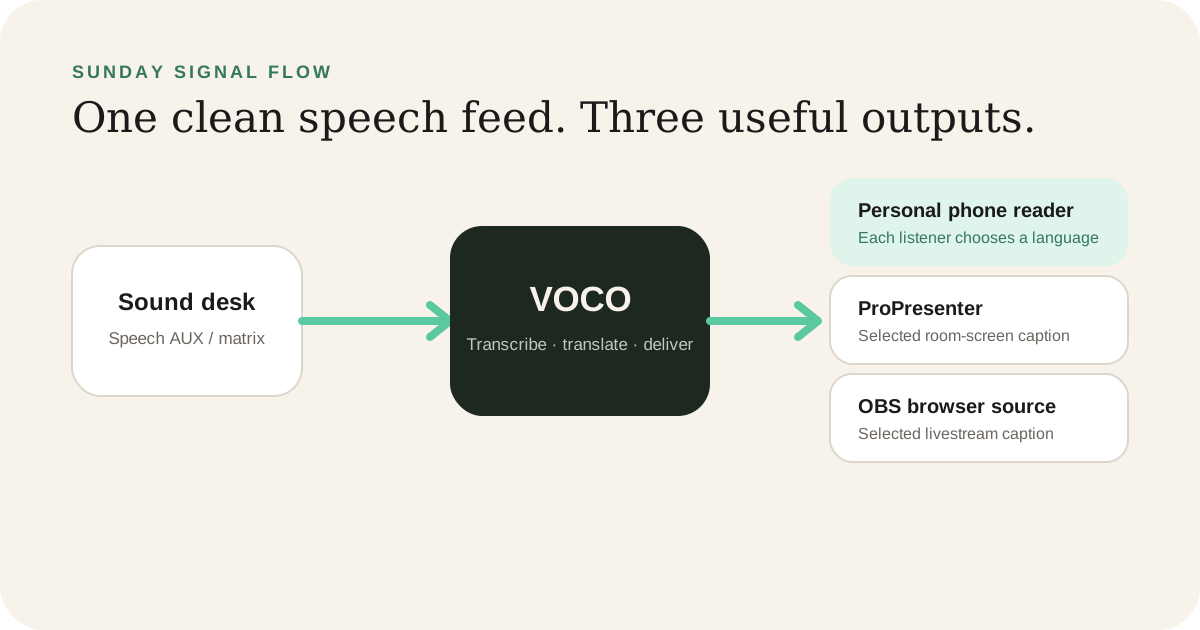
Add translation to the existing signal flow
Do not place a new room microphone beside the production desk if the church already has clean digital audio. Create a speech-focused auxiliary or matrix mix from the console and connect it to the Voco laptop through a USB audio interface.
Include the teaching microphone, host, notices, and any planned testimony mic; reduce music and crowd microphones where possible. Name and save the console scene so volunteers do not rebuild it weekly.
Translation should become a documented output alongside livestream, recording, lobby, and hearing assistance—not a secret cable understood by one engineer.
Separate the personal reader from public captions
The attendee reader and the room/livestream overlay solve different jobs. The personal QR route lets each listener choose from 200+ output languages without an app or account.
A public ProPresenter or OBS overlay normally shows one selected language or same-language captions for a wider audience. Avoid cycling a main screen through many languages; that makes the service harder to follow for everyone.
Give multilingual attendees personal control, then use shared captions only where they support a deliberate room or broadcast need.
Design the QR-code journey like any other guest experience
A technically perfect reader is useless if visitors never discover it. Put a small translation message on pre-service slides, foyer signage, the church website, and welcome-team notes.
Use one permanent church link and say that more languages are available after scanning. Test the code from the back row, on iPhone and Android, and on guest WiFi.
Keep a short URL for people whose camera will not scan and one church-owned tablet for people who do not have a suitable phone. The welcome team should know what the service is without needing to troubleshoot the dashboard.
Tune the system for preaching, panels, and transitions
Contemporary services often move quickly from video to host to worship to sermon, and may include panel conversations or several wireless microphones. Confirm that every important speech channel reaches the translation bus.
Panels need disciplined microphone use and minimal cross-talk. Prerecorded videos are better captioned and translated in post-production rather than routed through the live sermon system.
During music, pause expectations or supply prepared lyrics. Use the glossary for speaker names, church brands, series titles, campuses, theological vocabulary, and local place names.
- Save the translation mix and input device as part of the Sunday scene
- Add a translation check to the production run sheet
- Assign a second-phone check rather than continuous dashboard watching
- Review errors after the service and update the glossary before next Sunday
Measure ministry value rather than collecting identities
Anonymous language selections can show that people are using Spanish, Farsi, Korean, or another reader, but they do not reveal nationality and should not be treated as a census. Use the pattern to ask better questions: Is the QR code visible?
Does the language remain active for the sermon? Are people returning?
Then speak with attendees voluntarily and invite them into community, leadership, and feedback. A chart may reveal an access need; it cannot tell the pastoral story behind it.
Keep analytics proportionate and explain the reader’s privacy in plain language.
A production-ready evaluation plan
Use the 7-day trial to run a private full-service recording, a volunteer rehearsal, and one controlled live pilot. Check translation on real guest WiFi, verify the OBS or ProPresenter output if required, and simulate one cable or network interruption.
Voco Starter begins at £6/week; Church at £12/week adds multiple-service scope and AV integrations. Compare plans against the church’s real number of services and production outputs, not merely congregation size.
Completion means the normal volunteer team can run it from the documented Sunday checklist.
Frequently asked questions
Does Voco work with ProPresenter?
The Church plan includes a ProPresenter Web Item workflow for a selected caption or translation view. Personal attendee phones can simultaneously display their own chosen languages.
Can we add Voco to OBS for the livestream?
Yes, using a browser-source overlay on the appropriate plan. Test font size, safe area, timing, and the selected language before making it part of the public broadcast.
Can the same QR code work every Sunday?
Yes. Use the church’s permanent access route in slides, print, the website, and welcome-team material so guests learn one stable entry point.
Will it translate worship lyrics?
Do not rely on live speech recognition for sung lyrics. Prepare translated lyrics separately where licensing permits, or keep the live reader focused on spoken content.
Does translation data tell us attendees’ nationalities?
No. A selected language is not a nationality and should not be used to infer one. Use aggregated patterns to improve access, then build relationships through ordinary pastoral conversation and consent.