2026-08-27 · 9 min read
Welcoming Hong Kong BNO Families to Your UK Church: What Actually Helps
Cantonese, not Mandarin. Church background, not a blank slate. What UK churches actually need to know about the 160,000-plus Hong Kongers who have arrived since 2021.
By Josh Stannard, founder of Voco
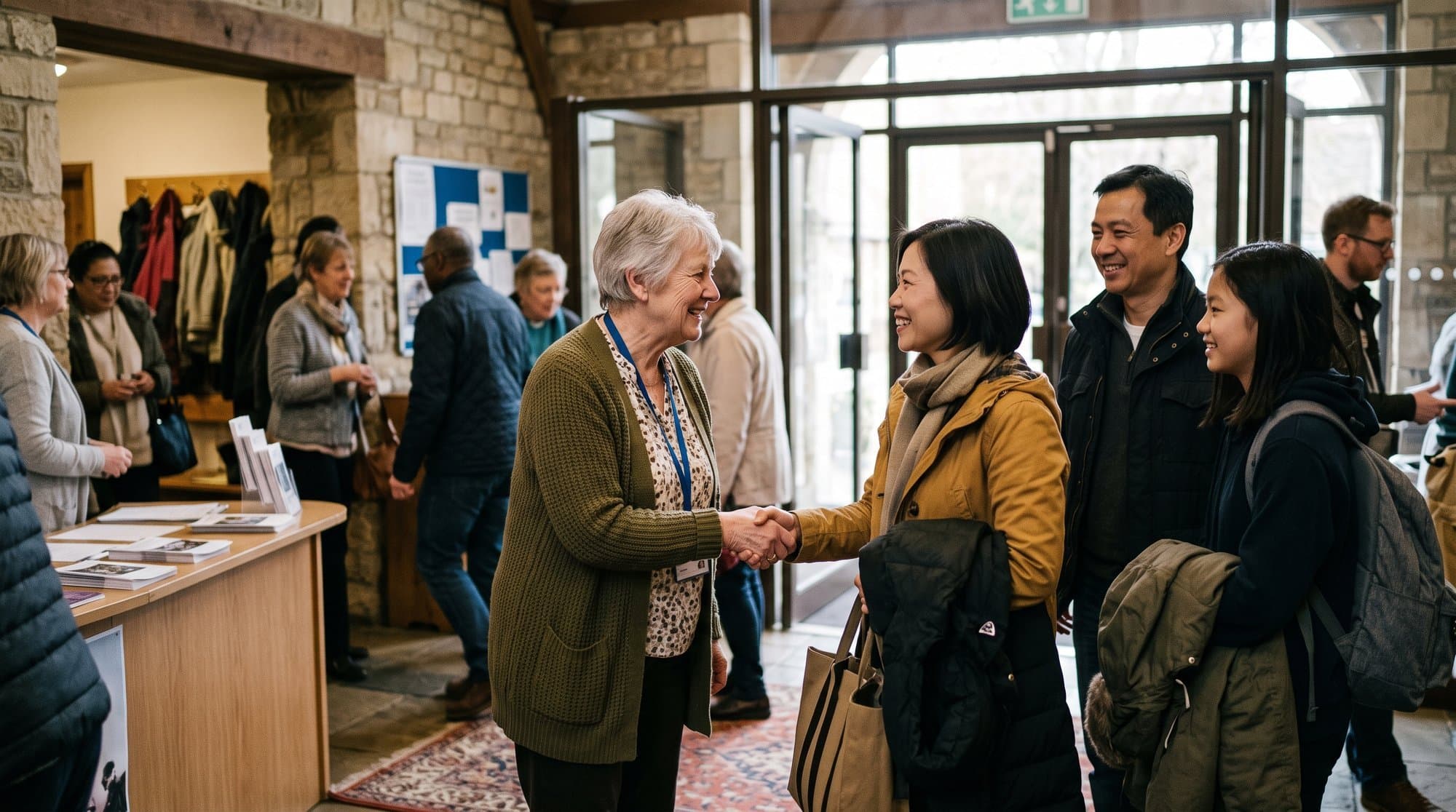
If a Hong Kong family has started turning up at your church in the last few years, you're not imagining a trend. Since the British National (Overseas) visa route opened in January 2021, more than 160,000 Hong Kongers have moved to the UK, according to ONS figures cited by the Migration Observatory at Oxford, with close to 200,000 holding a valid BNO visa by the end of 2025. This guide is about what genuinely helps once that family is in your pews, not the politics that got them there. There is a longer practical version of this guide if you want the checklist form.
Who's arriving, and where
The BNO route opened after China imposed a National Security Law on Hong Kong in 2020, and the numbers have kept climbing steadily since. Home Office statistics show 184,203 BN(O) visa grants issued in total as of the year ending September 2025, with settlement (Indefinite Leave to Remain) starting to come through for the earliest arrivals, since it requires five years of continuous residence. According to the Migration Observatory, around two-thirds of those who left cited feeling unsafe in Hong Kong as their reason, alongside concerns about their children's education.
They haven't settled evenly. Survey data collected for the Welcoming Committee for Hong Kongers, and separately by researchers at the University of Liverpool, both point to the same broad pattern: the South East and London hold the largest shares, followed closely by the North West, with Manchester, Reading, Birmingham, Nottingham and Bristol standing out as specific cities with sizeable Hong Kong communities. Smaller but notable clusters have formed in Sutton in south west London, Warrington, Solihull and Trafford, often around good schools and existing Hong Kong social networks rather than job markets specifically. If your church is in or near any of those areas, you're statistically likely to have Hong Kong families within reach even if none have found you yet.
This isn't a short-term wave that will pass. The BNO route remains open, arrivals have continued steadily each year since 2021 rather than spiking once and tapering off, and the earliest cohort is now becoming eligible for settlement after five years of continuous residence. Churches that treat this as a passing event, something to respond to and then move on from, will find the opposite is true: the Hong Kong presence in UK church life is becoming a permanent feature of the landscape, not a temporary one.
Cantonese, not Mandarin
This is the mistake that closes doors before a conversation even starts, and it's worth being specific about it.
Hong Kong's everyday language is Cantonese. Mandarin is mainland China's official language, and for many Hong Kongers, especially those who left after 2019's protests and the security law that followed, Mandarin carries real political weight. It's associated with Beijing, not home. A well-meaning church that puts up a Mandarin welcome sign, or assumes a Mandarin-speaking volunteer can act as the bridge to a Hong Kong family, can unintentionally land somewhere between clumsy and offensive.
The safer path, when you don't have a Cantonese speaker on hand, is often plain English rather than Mandarin. That's the approach Revd Dave Ho Young takes at St Barnabas Church in Leeds, where around a quarter of the congregation are Hong Kong émigrés, as he described in a 2023 piece for The Spectator: he speaks English to his Hong Kong congregants rather than risk the political undertone of Mandarin, and in return, they've been teaching him Cantonese. It's a small, specific example of a much larger pattern, language choice here is never just about comprehension.
If you can find or train a Cantonese speaker, even someone learning alongside the community rather than fluent from the start, that effort is noticed and valued. Many families will be patient with imperfect Cantonese in a way they won't be with fluent Mandarin offered in its place. If you have nobody at all, live Cantonese translation covers the sermon while you look for a person, and there is a directory of UK churches offering Cantonese worth pointing families to in the meantime.
Where you don't have a Cantonese speaker at all, and can't reasonably find or train one quickly, live translation software that supports Cantonese as one of its languages lets a family follow a service via a phone they already own, no interpreter roster to build, no app to install beforehand. It won't replace a genuine relationship with a Cantonese-speaking member of your team over time, but it removes the immediate barrier while that relationship is still forming.
This doesn't mean avoiding Mandarin speakers in your congregation altogether, plenty of UK churches now have both Cantonese-speaking Hong Kong members and Mandarin-speaking mainland Chinese members, often in the same room. It means not assuming the two communities are interchangeable, and being sensitive to the fact that some Hong Kong families have specifically left environments where Mandarin was imposed on them politically, in schools and public life, and may carry real feeling about that even in a UK church setting. Where both language groups are present, many churches find that keeping any Chinese-language provision separated by dialect, rather than blended, respects both communities better than a single "Chinese-language" catch-all does.
Church background: a different starting point
One thing that surprises churches new to this is how many Hong Kong arrivals already have a church background. Estimates vary depending on the source and how the question is asked, but figures from the British Chinese Christian community study put the proportion of Christians among Hong Kong immigrants to the UK at close to a quarter, notably higher than the roughly 18% estimated for the wider UK Chinese population. Hong Kong itself has a substantial Christian population, with historic Anglican, Catholic and independent evangelical roots dating back generations.
That matters practically. A family arriving with an existing faith background isn't starting a spiritual journey from zero, they're often looking for a church that feels recognisably like the one they left, or consciously looking for something different after difficult experiences with denominational politics back home. Either way, the research on UK Chinese congregations since 2021 tells a consistent story: churches serving this wave have seen real, sustained growth, some reporting annual growth rates approaching 30% among Cantonese-speaking congregations specifically, distinct from the more stable Mandarin-speaking congregations serving mainland Chinese students. More than 600 UK churches have joined welcome networks aimed at becoming, in the language some of them use, "Hong Kong ready."
Ask new families directly what kind of church background they're coming from, rather than assuming. Some will want a Cantonese-language service that echoes home. Others, particularly younger arrivals, are actively looking to integrate into an English-speaking congregation and may prefer that you don't treat them as a separate ministry track at all.
Some families have also left churches in Hong Kong under difficult circumstances entirely unrelated to language, denominational politics, disagreements over how their church responded to the 2019 protests and their aftermath, or a general sense of institutional distrust that extended to religious institutions as much as civic ones. A family that seems hesitant about deeper church involvement isn't necessarily disengaged from faith, they may simply be cautious about institutions after a difficult season, and that caution deserves patience rather than a push toward quicker commitment.
What helps practically
Schools first. Education for their children is one of the most commonly cited reasons families chose the UK, so a church that can offer genuine, practical help navigating the school admissions process, not just goodwill, earns trust fast.
Kids' ministry that doesn't assume fluency. Children often pick up English faster than their parents, but that doesn't mean they're comfortable in an unfamiliar children's ministry format on day one. A patient, observant volunteer matters more than a perfectly translated curriculum.
Language access on Sundays, without waiting for fluency. This is where the pace of "settling in" and the pace of understanding a sermon can be pulled apart, they don't have to move at the same speed. Live captions or translated audio, delivered through a QR code on a family's own phone rather than a headset or an app they'd need to download in advance, let a family follow the service in Cantonese from week one while their English develops in its own time.
A named contact who understands the practical side of arrival. Beyond schools and children's ministry, families are often navigating GP registration, opening a UK bank account, understanding council tax, and a dozen other small bureaucratic hurdles that feel large in a new country. A church doesn't need to solve these directly, but a volunteer who's walked through the same process recently, or a warm, specific referral to a local settlement support service, is worth more than generic goodwill.
Recognition that many families are also caring for elderly relatives. A meaningful number of BNO households include grandparents who moved with the family, and who face a much steeper language and integration curve than their children or grandchildren. A church's welcome that only reaches working-age adults and children misses this older generation entirely, and they're often the most isolated members of a newly arrived family.
Patience with the political weight some families carry. Many have left under real strain, and some will be wary of anything that feels like it's testing their politics rather than welcoming their presence. Neutral, warm, unhurried is usually the right register.
Understanding the settlement clock, even loosely. Families on the BNO route need five years of continuous UK residence before they can apply for settlement, and that timeline shapes decisions many won't necessarily explain to you, why they haven't bought a house yet, why they're cautious about long-term commitments, why a work situation matters more urgently than it might for a British-born family in a similar role. You don't need to become an immigration expert, but knowing this general shape helps you avoid unintentionally puzzling questions like "so when are you planning to settle down here properly?" to a family who already has.
Finding or becoming a Cantonese-friendly church
If a Hong Kong family has found their way to your church and you want to be genuinely ready for them, the practical checklist is short: a Cantonese greeting, a way to translate the service live without requiring an app or an interpreter roster you can't sustain, and leaders willing to ask rather than assume what a Cantonese-speaking congregation actually wants from you.
Voco supports Cantonese among its 50-plus languages, so a QR code and a phone already in someone's pocket is often enough to get a family through their first few Sundays while everything else settles (voco.church/translate/cantonese). If you're a Hong Kong family looking the other way around, for a church already set up to welcome you, voco.church/find-a-church/cantonese/uk lists churches by the languages they translate into.
Full disclosure: I built Voco, one of the tools mentioned here.
Frequently asked questions
What should churches know about who's arriving, and where?
The BNO route opened after China imposed a National Security Law on Hong Kong in 2020, and the numbers have kept climbing steadily since. Home Office statistics show 184,203 BN(O) visa grants issued in total as of the year ending September 2025, with settlement (Indefinite Leave to Remain) starting to come through for the earliest arrivals, since it requires five years of continuous residence. According to the Migration Observatory, around two-thirds of those who left cited feeling unsafe in Hon
What should churches know about cantonese, not mandarin?
This is the mistake that closes doors before a conversation even starts, and it's worth being specific about it.
What should churches know about church background: a different starting point?
One thing that surprises churches new to this is how many Hong Kong arrivals already have a church background. Estimates vary depending on the source and how the question is asked, but figures from the British Chinese Christian community study put the proportion of Christians among Hong Kong immigrants to the UK at close to a quarter, notably higher than the roughly 18% estimated for the wider UK Chinese population. Hong Kong itself has a substantial Christian population, with historic Anglican,
What should churches know about what helps practically?
Schools first. Education for their children is one of the most commonly cited reasons families chose the UK, so a church that can offer genuine, practical help navigating the school admissions process, not just goodwill, earns trust fast.
First published on Medium.