2026-09-21 · 10 min read
Translation Devices for Churches vs Phones: The 2026 Equipment Guide
FM systems, interpretation booths, and AI apps compared on real cost, from a $90 starter kit to a $20,000 professional install.
By Josh Stannard, founder of Voco
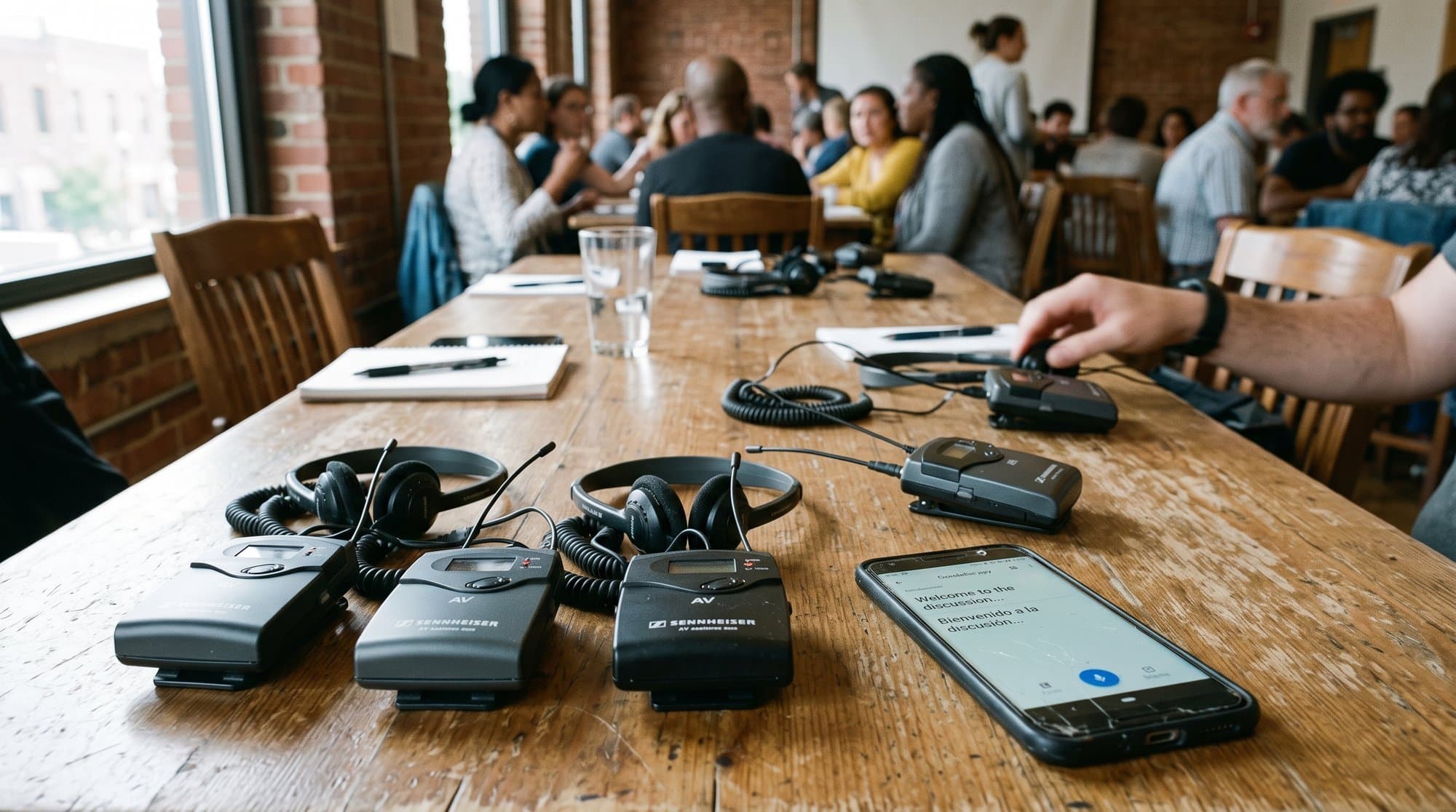
Before AI translation apps existed, a church that wanted to serve a multilingual or hard-of-hearing congregation had exactly one real option: buy hardware. FM assistive listening systems, dedicated interpretation booths, headsets and receivers by the dozen, checked out and collected like hymnals. Some of that hardware is still the right answer in 2026. Most churches, though, are better served by a phone in every pocket and a QR code on the wall.
Here's the actual cost comparison, with real prices, so you can make that call for your own building rather than taking anyone's word for it.
Full disclosure: I built Voco, one of the phone-based tools mentioned here.
The hardware options and what they really cost
FM assistive listening systems
These use a dedicated FM frequency to broadcast audio to small receivers, typically for hard-of-hearing attendees rather than translation specifically, though some setups run a second channel for interpretation.
Real, verified prices for common kits:
- Retekess TR503: around $90, includes 5 receivers, roughly 100ft range. Budget entry point, not ADA-rated.
- Hamilton Buhl ALS700: around $250 to $340, includes 6 receivers and earbuds, 150ft range, ADA compliant.
- Enersound 10-Person system: around $300, 10 receivers plus neckloops for hearing-aid compatibility, 500ft range, ADA compliant.
- Williams Sound PPA VP 37: around $380, 4 receivers included, 1,000ft range, telecoil compatible, expandable with additional receivers.
- EXMAX EX-938: around $390, supports up to 50 receivers on a UHF channel, often paired with a separate FM system to run translation and hearing assistance on independent channels.
For context on how many receivers you actually need: ADA guidance for assembly areas sets minimums based on fixed seating, roughly 2 receivers for a 50-to-200-seat venue and 4 for 200-to-500 seats, with at least 25% of those receivers needing to be hearing-aid compatible via neckloop. In practice, most guidance suggests aiming for enough receivers to cover 4 to 5% of your regular attendance, so a congregation of 200 would want 8 to 10 receivers on hand, not just the ADA minimum.
Interpretation booths and professional equipment
For genuine simultaneous interpretation, multiple languages, dedicated interpreters, at proper conference quality, dedicated booths and transmitter systems are the traditional answer. This is where the widely cited $5,000 to $20,000 figure for a full professional setup comes from, and it's realistic for a large multi-language installation with several interpreter booths and hundreds of receivers, not an exaggeration for that scale of deployment.
The ongoing cost matters as much as the upfront one: a professional setup still needs a human interpreter per language, and interpreter fees run separately from the equipment, commonly cited in the $200 to $500 per week per language range depending on your market and whether you're using volunteers or paid professionals.
The phone-based alternative
AI translation apps flip the entire cost structure. Instead of buying and maintaining hardware for every listener, you connect one microphone feed to a laptop or small interface, and every attendee's own phone becomes the receiver. The upfront hardware cost drops to whatever audio interface you need to bridge your existing sound system to a laptop, typically $30 to $100 for a basic USB interface, plus a laptop you likely already own.
Ongoing cost then becomes a subscription rather than a hardware line item. Real, verified examples from the current market:
- Aurelo: free forever tier at 2 hours/month, paid plans from €49/month for 10 hours up to €199/month for 50 hours
- Kaleo AI: $24/month for 5 hours, up to $149/month for unlimited hours
- Voco: £6/week Starter, £12/week Church (+VAT), 7-day free trial , no card required
- Hope Translator: free tier at 30 minutes/month, paid tiers from roughly $14/month
- LiveSunday: $5/hour pay-as-you-go, or $59/month for 12 hours
(Prices checked August 2026, confirm current figures before budgeting.)
The three-year cost comparison
This is the number that actually matters for a board decision, because a hardware purchase looks expensive in month one and cheap by year three, while a subscription looks cheap in month one and adds up. Here's how it plays out with real, verifiable inputs.
| Approach | Upfront cost | Ongoing cost | Approx. 3-year total (mid-size church) |
|---|---|---|---|
| FM system only (Enersound-class kit) | ~$300 | Minimal (batteries, occasional replacement) | ~$500–$800 |
| Professional interpretation booth setup | $5,000–$20,000 | Interpreter fees, $200–$500/week/language | $40,000–$100,000+ |
| Phone-based AI translation (mid tier) | $30–$100 (audio interface) | Subscription, e.g. £12/week or €49–199/month | ~$2,300–$8,000 |
Key takeaways from the table: a basic FM hearing-assist system remains genuinely the cheapest option over three years if hearing assistance, not translation, is your actual need, since it has almost no ongoing cost. Professional interpretation booths are, unsurprisingly, the most expensive path by a wide margin, driven almost entirely by ongoing interpreter fees rather than the hardware itself. Phone-based AI translation sits in the middle for total cost, but delivers translation into dozens of languages simultaneously, something no FM system does at any price, since FM hardware broadcasts audio, it doesn't translate it.
What a real hardware deployment actually involves week to week
The sticker price of an FM system or interpretation booth is only part of the real cost, the ongoing logistics matter just as much for a volunteer-run church. Someone has to check receivers out before the service and collect them afterward, usually stationed at a table near the entrance, which means recruiting and training a volunteer for that specific job every single Sunday. Batteries need charging or replacing on a schedule, and a receiver that dies mid-service during the sermon is a worse experience for that attendee than never having one at all. Units get lost, damaged, or walk out the door in someone's coat pocket, and most churches running FM systems budget for a small annual replacement cost as a result, on top of the original purchase.
None of that is a reason to avoid hardware if it's genuinely the right tool for your need. It's a reason to factor the staffing and logistics cost into your decision alongside the sticker price, because a $300 FM kit that needs a dedicated volunteer every week for years has a real ongoing cost that doesn't show up on the receipt.
When hardware still wins
FM systems aren't obsolete. If your primary need is hearing assistance rather than language translation, a simple, ADA-compliant FM kit is still the right, and cheapest, tool for the job, and it works without WiFi, without a smartphone, and without any dependency on an internet connection during the service. A hard-of-hearing member doesn't need AI translation, they need clean, amplified audio delivered directly to their ear, and a $300 FM kit does that reliably for years with almost no ongoing cost.
Interpretation booths still make sense for the rare church running genuinely large, multi-language conferences with hundreds of attendees per language and a need for the highest possible interpretation quality that only a trained human interpreter can currently deliver, particularly for nuanced theological content where AI translation still occasionally stumbles.
When phones win
For the much more common case, a church wanting to serve multiple language groups without spending five figures upfront, phone-based AI translation is the clear economic and practical winner. No hardware to check out and collect, no receivers to charge or replace, no limit on how many languages can run at once beyond what your software plan allows, and a visitor who's never been to your building before can start using it in the time it takes to scan a code.
I have been in a very large church that did this properly, with people. Events running into Spanish, Portuguese, Russian, German, more or less anything you could name, because they had students from all over the world who could do it.
It worked, and it was wonderful to be around. It also needed headsets, designated booths, recordings, and audio routed around the building to make any of it happen. That is a real expense, and for most churches it is simply out of reach. Even hiring it in for one event is a cost most congregations cannot justify.
The hybrid approach many churches actually land on
It's worth naming a third option that doesn't fit neatly into "hardware" or "phones," because a meaningful number of churches end up running both simultaneously rather than choosing one. A basic FM or neckloop system stays in place specifically for hearing-assistance needs, since it works without WiFi, needs no smartphone literacy from an older member who might not have one, and delivers audio directly and reliably to a hearing aid. Alongside that, a phone-based AI translation tool handles the language side for visitors and international members, since it scales to as many languages as your software plan allows without buying a single additional receiver.
This isn't a compromise position, it's often the genuinely correct answer, because hearing assistance and language translation are different needs solved by different tools, and trying to force one system to do both jobs usually means it does neither particularly well. A church running both in parallel spends more in total than choosing only one, but considerably less than a full professional interpretation booth setup, while serving both audiences properly.
The maintenance and support cost nobody quotes upfront
There's a cost category that rarely appears in any vendor's pricing table but matters for a fair three-year comparison: who fixes it when something breaks. FM hardware failures are usually simple and cheap, a dead battery, a cracked receiver casing, a transmitter that needs a firmware update once every couple of years, and a reasonably technical volunteer can handle most of it without outside help. Professional interpretation booth installations, by contrast, often carry a service contract or at minimum an occasional call-out fee for a technician, since the equipment is more complex and the stakes of a failure during a live multi-language event are higher.
Software subscriptions shift that maintenance burden almost entirely onto the vendor, which is one of their most underrated advantages: a bug in the translation engine, a new language added to the model, an update to handle a tricky accent better, all of that ships to you automatically as part of the subscription, with no technician visit and no separate maintenance contract to negotiate. That's not a reason to dismiss hardware, some churches genuinely prefer owning something outright and not depending on a vendor's uptime, but it's a real factor in any honest total-cost comparison, and one worth naming plainly rather than leaving it as a footnote.
What to physically test before you buy either path
Whichever direction you lean, test it in your actual building before committing budget, not in a showroom or a demo video shot somewhere else. For FM systems, walk the full range of your sanctuary with a receiver switched on, including balconies, side rooms, and anywhere with structural interference like thick pillars or metal ductwork, since range specifications are measured in open, unobstructed conditions that rarely match a real building. For phone-based translation, test on the actual WiFi your congregation will use, at capacity, during a normal service, not on an empty building's network at its best. A tool that performs perfectly with ten people connected can behave very differently with three hundred phones competing for the same router.
A simple decision framework
Ask yourself three questions. First, is the core need hearing assistance for existing English speakers, or translation into other languages? If it's purely hearing assistance, an FM system is still your cheapest, most reliable option. Second, how many languages do you need running simultaneously? One or two, an FM-adjacent interpretation setup might suffice; three or more, and phone-based AI translation becomes the only realistic option at reasonable cost. Third, what's your appetite for upfront capital spend versus ongoing subscription? A board that would rather spend once and be done will lean toward hardware; a board that prefers predictable monthly costs and the flexibility to pause during quiet seasons will lean toward software.
According to RNID, one in three UK adults are deaf, have hearing loss, or experience tinnitus, over 18 million people, which is a strong reminder that hearing assistance and language translation are related but genuinely separate needs, and it's worth budgeting for both rather than assuming one solves the other.
Frequently asked questions
What should churches know about the hardware options and what they really cost?
These use a dedicated FM frequency to broadcast audio to small receivers, typically for hard-of-hearing attendees rather than translation specifically, though some setups run a second channel for interpretation.
What should churches know about the phone-based alternative?
AI translation apps flip the entire cost structure. Instead of buying and maintaining hardware for every listener, you connect one microphone feed to a laptop or small interface, and every attendee's own phone becomes the receiver. The upfront hardware cost drops to whatever audio interface you need to bridge your existing sound system to a laptop, typically $30 to $100 for a basic USB interface, plus a laptop you likely already own.
What should churches know about the three-year cost comparison?
This is the number that actually matters for a board decision, because a hardware purchase looks expensive in month one and cheap by year three, while a subscription looks cheap in month one and adds up. Here's how it plays out with real, verifiable inputs.
What should churches know about what a real hardware deployment actually involves week to week?
The sticker price of an FM system or interpretation booth is only part of the real cost, the ongoing logistics matter just as much for a volunteer-run church. Someone has to check receivers out before the service and collect them afterward, usually stationed at a table near the entrance, which means recruiting and training a volunteer for that specific job every single Sunday. Batteries need charging or replacing on a schedule, and a receiver that dies mid-service during the sermon is a worse ex
First published on Medium.