2026-08-27 · 9 min read
The New Faces at the Back: Welcoming Nigerian, Congolese and Eastern European Families to UK Churches
UK churches are more international every year. What genuinely helps Nigerian, Congolese and Eastern European families feel like more than guests.
By Josh Stannard, founder of Voco
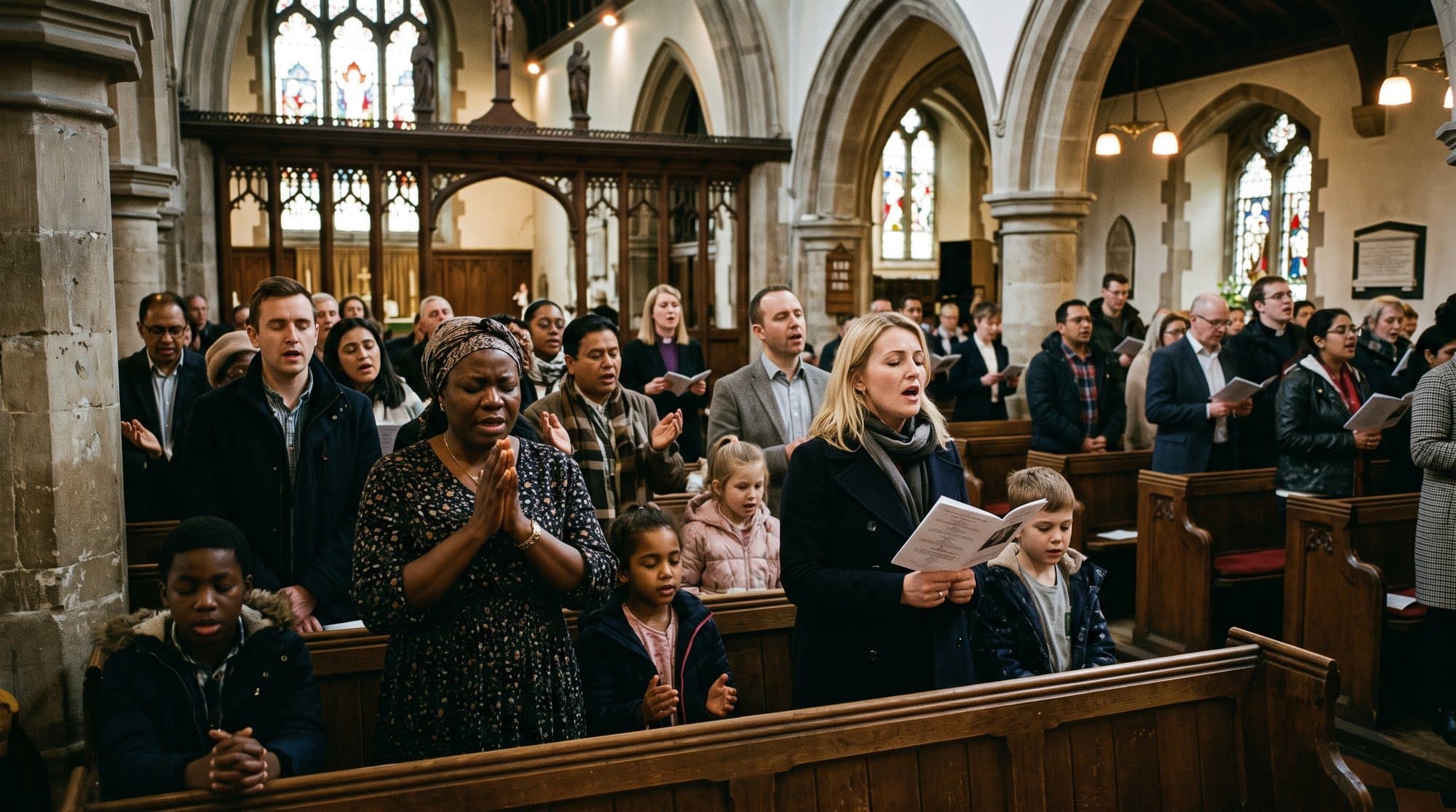
Walk into most UK churches on an ordinary Sunday now and you'll hear more than English in the foyer. Nigerian, Congolese and Eastern European families have become a steady, growing presence in British congregations over the last two decades, and the numbers back up what a lot of church leaders have already noticed without needing a statistic to tell them.
The new UK church map
According to the 2021 Census, 270,768 usual residents of England and Wales were born in Nigeria, up from 191,183 in the 2011 Census, a rise of around 42% in a decade, and Nigeria now sits among the top 15 countries of birth for the population of England and Wales. The same Census recorded 29,009 residents of England born in the Democratic Republic of Congo, up from 18,913 a decade earlier, most having arrived through refugee and asylum routes since the early 1990s, with the largest concentrations in London boroughs including Hackney, Tottenham, Newham and Barking and Dagenham. Polish-born residents number in the hundreds of thousands across the UK, one of the largest foreign-born populations in the country since Poland's 2004 EU accession, alongside a significant and growing Romanian community since Romania's accession in 2007.
None of that is news to a church that's watched its own membership shift. What follows is what actually helps, community by community, plus the thread that connects all three.
It's worth saying plainly why these three communities specifically, when the actual mix in most UK churches is wider still: they represent three genuinely different migration stories, economic and faith-driven migration from Nigeria, refugee displacement from Congo, and EU-era labour migration from Poland and Romania, and between them they illustrate most of the situations a UK church leader is likely to encounter from any community, not just these three. The specific detail matters, but the underlying questions to ask are transferable to whichever community actually walks through your doors.
Nigerian families
Many Nigerian families arrive with strong, often lifelong church backgrounds, Nigeria has one of the largest Christian populations in the world, and expressive, participatory worship, extended sermons, and a culture of active lay involvement in church life are often the norm rather than the exception. A Nigerian family visiting a quieter, more liturgically restrained English service may find it unfamiliar in either direction, some will appreciate the calm, others will find it flat compared to what "church" has always meant to them.
What helps: don't assume every Nigerian family wants, or doesn't want, a more expressive worship style, ask rather than default either way. Recognise and make use of existing leadership gifts, many arrive with substantial experience preaching, leading worship, or running ministries, and a church that only ever offers a welcome-team role to a gifted, experienced leader is underusing what's actually available. English fluency is usually high, since English is Nigeria's official language, but Pidgin English and a range of Nigerian languages, Yoruba, Igbo, Hausa among the largest, remain in everyday use at home and within community life, worth knowing rather than assuming full linguistic assimilation.
Many UK cities now also have established Nigerian-led churches, often Pentecostal or independent evangelical in tradition, some of which have grown substantially over the past two decades. A Nigerian family attending an English-led church isn't necessarily doing so because a Nigerian church isn't available nearby, sometimes it's proximity, sometimes it's a specific relationship, sometimes it's a deliberate choice to integrate rather than gather within a diaspora congregation. Worth asking, gently, rather than assuming the answer.
Congolese families
The UK's Congolese community is overwhelmingly shaped by displacement, most arrived as refugees or asylum seekers fleeing conflict in the Democratic Republic of Congo, particularly from the early 1990s onward, and many carry that history directly into how they experience a new church. Language is often French first, alongside Lingala, Kikongo, Tshiluba or Swahili depending on region of origin, with English typically a second or third language learned after arrival. Many Congolese Christians in the UK come from Catholic or Anglican backgrounds, though the community also includes substantial evangelical and independent African-church traditions.
What helps: French-language or French-supported translation matters more than many churches expect, since English fluency can lag behind other integration markers even years after arrival. Trauma-aware pastoral care, gently and without probing, given the refugee route many families have travelled. And, as with any refugee community, patience with the practical weight of navigating UK bureaucracy, housing, benefits, immigration status, alongside spiritual life, rather than treating the two as separate concerns a church only addresses one of.
Worship style within Congolese Christianity varies considerably by tradition, Catholic and Anglican-background families often expect more structured, liturgical worship, while those from evangelical or independent African-church backgrounds may be used to something closer to the expressive style more commonly associated with West African Pentecostalism. As with the Nigerian community, don't assume a single "African worship style" exists, the actual range is wide even within one country's diaspora.
Eastern European families
Polish and Romanian communities in the UK are large, well-established, and often less visible in ordinary church life than their numbers would suggest, partly because many Polish families are Catholic and have built their own dedicated Polish-language parishes rather than integrating into English Protestant congregations, and partly because economic migration patterns, arriving for work rather than as refugees, can mean families are more transient, more likely to be working long or unusual hours, and less immediately oriented toward finding a new church community at all.
What helps: recognising that "we have an Eastern European member" often undersells real diversity, Polish Catholic tradition, Romanian Orthodox backgrounds, and a smaller but present Romanian evangelical presence are genuinely different starting points, not one culture. Practical accommodation for shift-work patterns common among Eastern European workers in logistics, agriculture, and care work, a church that only ever meets during standard commuting hours may simply be inaccessible to some families, regardless of interest. And for Romanian and Polish speakers who aren't yet confident in English, translated service content removes a barrier that otherwise quietly limits how deeply someone can engage even after years of attending.
Because a meaningful share of Poland's Catholic diaspora already worships within dedicated Polish-language parishes, a Protestant or Anglican church that gains a Polish family is often reaching someone specifically outside that default pattern, perhaps drawn by a particular relationship, a specific ministry, or a deliberate choice about denomination rather than default cultural attendance. Understanding that a Polish family in an English evangelical church has often made an active choice, rather than simply ended up there, is worth appreciating rather than assuming they're a substitute for the Polish parish down the road.
The common thread: language access and genuine role
Nigerian, Congolese and Eastern European families arrive through entirely different routes, for entirely different reasons, and flattening them into a single "international ministry" strategy misses what each actually needs. But one thing holds across all three, and across most immigrant communities a UK church is likely to encounter: language access removes the first and most persistent barrier to belonging, and a genuine role, not just a warmly offered guest status, is what turns attendance into membership.
Live translation that doesn't require an app or a costly interpreter roster, a QR code and a phone people already carry, can cover the gap for French, Yoruba speakers still building English confidence, Polish, Romanian, or any of the dozens of languages a genuinely mixed UK congregation now includes. Voco supports 50-plus languages for exactly this reason (voco.church/languages).
What a genuine role actually looks like
It's worth being specific about the difference between guest status and genuine role, since the phrase is easy to nod along with and harder to practise. Guest status looks like: always being welcomed, never being asked to serve on a rota. Always being consulted about "diversity" but never about the church's actual budget or direction. Always appearing in outreach photography, never appearing in a leadership meeting.
A genuine role looks like the reverse of each of those, and it usually starts smaller than a full leadership appointment. Someone from a Nigerian background helping lead worship once a month, not as a special "international Sunday" but as an ordinary part of the rota. A Congolese member consulted on a decision that affects the whole church, not just decisions framed as being about "the Congolese community specifically." A Polish family's teenager serving on the tech team like any other teenager, rather than only ever being introduced as "our Polish family's son."
None of this requires lowering any bar for competence or readiness, it requires actively looking for where competence and readiness already exist among newer members, rather than defaulting to existing leadership because that's simply who's always been asked.
A practical starting checklist
For a church wanting to move from good intentions to something concrete this month: identify which language groups are actually present in your congregation right now, not hypothetically, by asking your welcome team and children's ministry leaders directly. Pick one Sunday to trial live translation for whichever language would help the most people, and treat it as a genuine experiment rather than a permanent commitment either way. Ask at least one person from each community represented in your church what they'd find helpful, and, just as importantly, what they wouldn't. And look, honestly, at your current leadership and volunteer teams: who's missing that shouldn't be, given who's actually in your congregation.
None of these steps require a large budget or a formal programme launch. They require attention, and a willingness to be led, in small ways, by people your church hasn't traditionally looked to for leadership.
It's also worth resisting the pressure, common in churches keen to be seen doing this well, to move faster than the relationships themselves warrant. A leadership role offered too early, before trust has genuinely built in both directions, can feel like tokenism even when the intention behind it is completely sincere. The families and individuals this guide describes will tell you, in their own time and in their own way, when they're ready for more. The work is mostly listening well enough to notice.
That patience applies just as much to the language question this whole guide keeps returning to. A church doesn't need to solve translation perfectly on the first Sunday it tries. It needs to keep showing up with the willingness to try, to ask what worked and what didn't, and to adjust. Most of the churches that end up genuinely welcoming to Nigerian, Congolese, Eastern European and any other newly arrived families got there slowly, one imperfect Sunday at a time, not through a single well-designed programme launch.
For the deeper practical guide to welcoming any of these communities specifically, dedicated resources exist for Nigerian families (voco.church/resources/welcoming-nigerian-families-uk-church), Congolese families (voco.church/resources/welcoming-congolese-families-uk-church), and Eastern European families (voco.church/resources/welcoming-eastern-european-families-church).
Full disclosure: I built Voco, one of the tools mentioned here.
Frequently asked questions
What should churches know about the new uk church map?
According to the 2021 Census, 270,768 usual residents of England and Wales were born in Nigeria, up from 191,183 in the 2011 Census, a rise of around 42% in a decade, and Nigeria now sits among the top 15 countries of birth for the population of England and Wales. The same Census recorded 29,009 residents of England born in the Democratic Republic of Congo, up from 18,913 a decade earlier, most having arrived through refugee and asylum routes since the early 1990s, with the largest concentration
What should churches know about nigerian families?
Many Nigerian families arrive with strong, often lifelong church backgrounds, Nigeria has one of the largest Christian populations in the world, and expressive, participatory worship, extended sermons, and a culture of active lay involvement in church life are often the norm rather than the exception. A Nigerian family visiting a quieter, more liturgically restrained English service may find it unfamiliar in either direction, some will appreciate the calm, others will find it flat compared to wh
What should churches know about congolese families?
The UK's Congolese community is overwhelmingly shaped by displacement, most arrived as refugees or asylum seekers fleeing conflict in the Democratic Republic of Congo, particularly from the early 1990s onward, and many carry that history directly into how they experience a new church. Language is often French first, alongside Lingala, Kikongo, Tshiluba or Swahili depending on region of origin, with English typically a second or third language learned after arrival. Many Congolese Christians in t
What should churches know about eastern european families?
Polish and Romanian communities in the UK are large, well-established, and often less visible in ordinary church life than their numbers would suggest, partly because many Polish families are Catholic and have built their own dedicated Polish-language parishes rather than integrating into English Protestant congregations, and partly because economic migration patterns, arriving for work rather than as refugees, can mean families are more transient, more likely to be working long or unusual hours
First published on Medium.