2026-09-10 · 13 min read
How to Run a Multilingual Church Service: The Complete Playbook
Formats, translation, worship, and welcome, the practical playbook for running a service that actually works in more than one language.
By Josh Stannard, founder of Voco
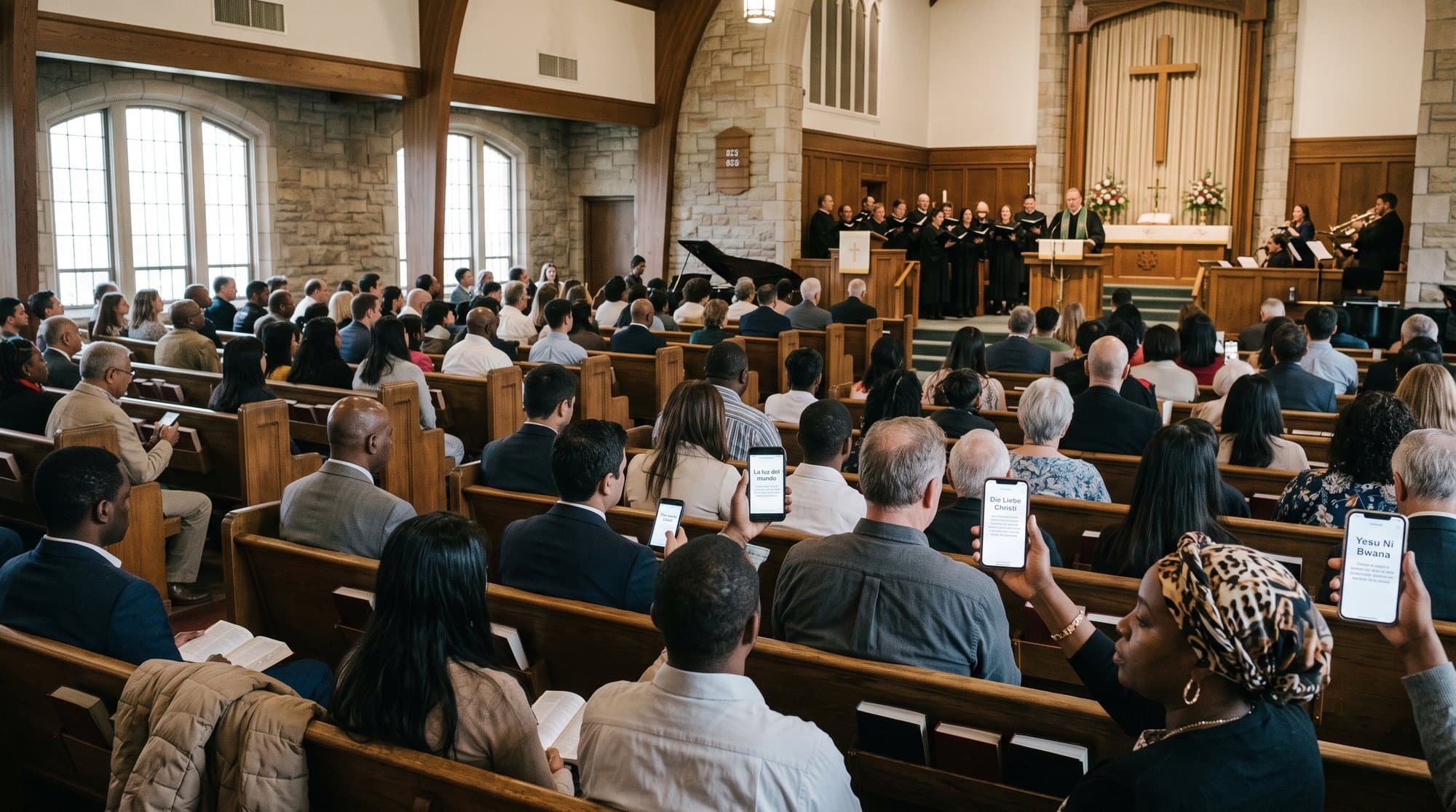
Picture a 90-person church in Leeds. Ten years ago the congregation was almost entirely white British. Now, on a normal Sunday, you'll hear Portuguese in the foyer, Farsi in the crèche, and at least three different accents of English from the welcome team. Nobody planned this. It happened one family, one referral, one answered prayer at a time, and now the pastor is standing at the front on a Tuesday night wondering how on earth Sunday's meant to work for everyone.
If that's roughly your situation, this is the playbook. Not theory, a working guide to the five real ways churches run multilingual services, how to pick the right one for your congregation, and the specific things that break when you do it badly (tokenism, volunteer burnout, the "translation ghetto" where non-English speakers sit at the back with headsets and never quite feel part of the room).
There's no single right answer to running a multilingual church service. There's a right answer for your congregation, this year, given who's actually in the room. This guide will help you find it.
The five service formats
Every multilingual church, whether it knows it or not, is running one of five formats. Knowing which one you're in, and which one you're drifting toward, changes everything about what you plan next.
1. Parallel services
You run separate services in separate languages, often in different rooms or at different times. A 9am English service and an 11am Spanish service. Two congregations sharing a building, sometimes sharing very little else.
Pros: each group gets a service entirely in their own language, at full speed, with no compromise on flow. Preaching doesn't lose 40% of its length to translation. Music can be chosen for one language's ear, not stretched across two. Leaders can preach with the idioms, humour, and cultural references that land naturally in their own language, rather than pre-editing every sentence to survive translation.
Cons: this is the format most likely to calcify into two churches that happen to share a car park. Without deliberate cross-pollination, shared leadership meetings, joint events, mixed serving teams, parallel congregations drift apart. The "same church" claim starts to ring hollow. Budgets tend to follow whichever congregation has been there longest, and the newer language service often ends up with the worse time slot, the smaller room, or the leftover volunteers, even without anyone deciding that on purpose.
When it's the right call: two language groups of meaningful, roughly comparable size, each large enough to sustain its own full service (worship team, children's ministry, pastoral care) without stretching either community thin. Works best when leadership actively schedules joint events rather than assuming proximity will build unity on its own.
2. Integrated bilingual
One service, two (or more) languages woven through it, readings in one language then the other, a sermon delivered with live or consecutive translation, songs sung in both. Everyone's in the same room, all the time.
Pros: genuine unity. Nobody's segregated. Kids from mixed households grow up hearing both languages treated as normal, not as an accommodation. Visitors who speak neither language fluently still get a strong signal that this church values inclusion in practice, not just in a mission statement.
Cons: service length balloons if you translate everything (more on that trap below), and if you're not careful, the majority language always leads and the minority language always follows, which quietly tells people who's the "real" congregation.
When it's the right call: congregations where the language groups are genuinely mixed at the level of families and friendship groups, not just present in the same building. Works less well if one group significantly outnumbers the other and the smaller group's presence starts to feel like a permanent guest slot rather than genuine co-ownership.
3. Translation-assisted
The service runs in one primary language throughout, and other language speakers follow via translation, historically headsets and an interpreter booth, now more commonly live captions on a phone via a QR code. The room stays unified; the language layer sits on top.
Pros: the format scales without adding service length. A room of six languages doesn't need six times the runtime, everyone follows the same clock, just with different words. This is the format most churches land on once they've outgrown two languages and can't run a "parallel service" for every one of them.
Cons: if the translation lags, garbles, or drops out, the non-primary-language listeners feel it immediately, and they're the ones least likely to say so. Audio quality becomes the single point of failure.
When it's the right call: this is the format that scales best once you've got more than two or three languages present, or when the smaller language groups are too small individually to justify a dedicated service. It's also the fastest format to stand up from scratch, a church that discovers three Ukrainian families are attending this coming Sunday can have translation-assisted support running within days, which isn't true of any of the other four formats.
4. Rotating language
The primary language of the service itself rotates, English leads one month, Spanish the next, French the one after. Everyone experiences being the minority-language listener some of the time, and being fully understood the rest.
Pros: genuinely equalising. No language is permanently "the default." It's a strong statement of value, and congregations that do this well report it changes how people treat each other, not just how the service sounds.
Cons: logistically demanding. You need preaching and worship leadership fluent (or translation-fluent) in every rotating language, every time. Small churches rarely have the bench strength. It also asks something significant of the majority-language group, who now spend a third or a quarter of their Sundays following along in a language they don't speak, a genuinely good discipline, but one that needs explaining clearly, or it reads as inconvenience rather than intentional equality.
When it's the right call: churches with two or three genuinely comparable-sized language communities and multiple fluent leaders across each. Rare in practice, but powerful where it's sustainable, congregations that maintain rotating language format for several years consistently describe it as changing the whole culture of the church, not just the Sunday service.
5. Hybrid
Most churches, if they're honest, end up here: a primary language backbone with translation-assisted support for smaller language groups, occasional fully bilingual elements (a song, a blessing, a testimony) in the second-largest language, and parallel services only where numbers genuinely justify a dedicated room. Hybrid isn't a compromise so much as a recognition that a congregation with five language groups of wildly different sizes needs five different answers, not one format applied uniformly.
Pros: flexible and realistic. It matches infrastructure to actual need rather than forcing every language group through the same mould, and it can absorb a new language group arriving suddenly without requiring a full restructure.
Cons: without a clear underlying logic, hybrid can drift into inconsistency, one group gets a dedicated service, another gets a QR code, and nobody can quite explain why one language "earned" more than another. Write the logic down (attendance thresholds, growth trajectory, leadership availability) so decisions are explainable, not just historical accidents.
When it's the right call: almost every growing multilingual church, eventually. This is less a fifth option chosen deliberately from the start and more the format most congregations grow into as their language mix diversifies past what any single pure format can hold.
Choosing your format: a decision guide
Ask three questions before you touch a running order.
How many languages, and how big is each group? Two roughly equal-sized groups can sustain integrated bilingual or parallel services. Five groups where one has 40 people and the rest have six each points hard toward translation-assisted or hybrid, you cannot build a dedicated format around six people without exhausting your volunteers.
How fluent are the leaders you already have? Rotating language format needs preachers and worship leaders who can genuinely lead in more than one language, not just translate a script. If that's one person on your team, rotating format will burn them out inside a year.
What's growing, and what's shrinking? A Spanish-speaking group that's doubled in eighteen months needs a different answer than one that's been steady at fifteen people for five years. Build for where the numbers are heading, not just where they are.
A useful rule of thumb: when a single non-English-speaking group crosses roughly 15-20% of a Sunday congregation, translation-assisted or a dedicated parallel service usually becomes worth the investment. Below that, integrated bilingual elements (a song, a reading, a welcome) tend to do more good per hour of volunteer time than a full separate infrastructure.
Worth adding a fourth question, less often asked: what does the room actually want? Leaders sometimes assume a language group wants a fully separate service when what they actually want is to be more visibly present and heard within the existing one, or the reverse, assuming everyone wants integration when a specific community would rather worship in their own language, at their own pace, without constantly code-switching for the room's benefit. Ask directly, more than once, rather than designing the format entirely from the platform.
The translation layer
Whichever format you land on, someone has to actually do the translating. There are broadly three routes.
Human interpreters, live or consecutive. The gold standard for accuracy and warmth, a trained interpreter reads tone, humour, and theological nuance in a way software still can't fully match. The cost is availability: trained church interpreters are rare, and burnout is real if the same two people carry every Sunday.
Interpretation equipment (headsets and booth). Reliable, private, well understood by AV teams who've worked with conference tech before. The barrier is cost and setup time, headset systems typically run into the thousands, and someone has to collect, charge, and sanitise forty headsets every week.
QR-code live translation software. A phone or laptop mic feeds a translation engine, and the congregation reads captions on their own phone via a QR code, no app, no headset queue. This is Voco's lane specifically: no hardware to manage, 200+ attendee languages available from one setup, and a congregation member can join mid-service just by scanning a code on the screen. Full disclosure: I built Voco, one of the tools mentioned here. It won't out-nuance a skilled human interpreter on a subtle joke or a piece of theological wordplay, for that, nothing beats a person who knows both languages and your church. Where it wins is coverage: the Sunday you don't have an interpreter booked, or the visitor who speaks a language nobody on your team does, it's still there.
Most healthy multilingual churches use a mix: trained interpreters for their two or three largest language groups, translation software as the safety net for everyone else and for the Sundays the usual interpreter is away.
Multilingual worship without chaos
Music is where multilingual services most often go wrong, because well-meaning worship leaders try to translate everything and end up with songs that limp in both languages.
A few things that consistently work, drawn from how established multilingual churches run their music (the Calvin Institute of Christian Worship has documented several of these approaches in detail, see their guide to multilingual worship for real congregation examples):
- Pick songs written bilingually from the start, rather than translating English worship songs into Spanish or Portuguese after the fact. Word-for-word translation rarely fits the melody's phrasing, and the seams show.
- Alternate by verse or chorus, not by song. A congregation singing verse one in English and verse two in Spanish stays together far better than "two songs in English, then two in Spanish," which just recreates the parallel-service problem inside the music set.
- Use lyric slides with both languages visible at once, side by side or stacked, rather than switching the whole slide. People pick up the second language faster when they can see it alongside the one they know.
- Let the smaller language group lead sometimes. If your biggest group is English and your worship team defaults to English every week, the "welcome" is theoretical. A Sunday where the smaller group leads a song in their own language, unaccompanied by translation, says more than any spoken statement of inclusion.
The welcome experience
Multilingual starts before anyone reaches their seat. It starts in the car park.
Signage. Entrance signs, toilet signs, and "welcome" boards in every language spoken by more than a handful of your congregation cost almost nothing and say a great deal. A single laminated sign that says "Bienvenidos" next to "Welcome" tells a Spanish-speaking visitor something a warm handshake alone can't.
Greeters who match your languages. If 20% of your Sunday attendance speaks Portuguese, at least one greeter on the door should too, ideally rostered, not left to chance.
Bulletins and orders of service in more than one language. This doesn't need to be every language every week. Even a QR code on the printed bulletin linking to a translated digital version removes the barrier for a visitor who'd otherwise sit through the service unsure what's happening next. Voco's church welcome tools include a multilingual welcome message generator built for exactly this, a quick way to put together a welcome that actually reads naturally in more than one language, rather than a Google-Translated afterthought.
The first-time visitor moment specifically. A visitor who doesn't speak the room's main language decides within the first ten minutes whether they'll come back, often before the service has properly started. That moment usually turns on something small: a greeter who made eye contact and tried a word of their language, a printed welcome card they could actually read, someone sitting next to them who noticed they looked lost and quietly helped. None of this needs a budget. It needs someone on the welcome team briefed to watch for it.
Common failure modes
Four patterns show up again and again in churches attempting this, worth naming honestly.
Tokenism. One song in Spanish once a quarter, framed as "celebrating our diversity," while every real decision, every leadership meeting, and every budget line stays monolingual. Congregations notice the gap between the gesture and the substance faster than leaders think.
Volunteer burnout. The same two bilingual volunteers translate every single Sunday, every meeting, every pastoral visit, because they're the only ones who can. Multilingual ministry that depends on two irreplaceable people isn't sustainable ministry, it's a countdown to a Sunday with no translation at all.
The translation ghetto. Non-English speakers physically clustered at the back with headsets, present but visibly separate, never integrated into serving teams, never given a platform. Translation infrastructure should make people feel more included, not mark them out as the group that needs extra help.
Format without leadership. Choosing a beautiful format on paper, say, rotating language, without the leadership bench to sustain it. The format collapses back to whatever's easiest within a few months, and the congregation reads that collapse as a broken promise.
The fix for all four is broadly the same: multilingual church isn't a feature you switch on. It's a leadership commitment that shows up in who's in the room when decisions get made, not just what language is spoken from the platform on Sunday.
Where to go from here
This playbook is deliberately the wide view. If you already know your format, the next steps are practical:
- Running one live service this Sunday? Get the audio path and the QR code rehearsed before you announce anything.
- Deciding between bilingual formats? Do the timing maths first. Some formats quietly double your service length and some do not.
- Spanish is very likely your first or largest language need, and live captions are the fastest way to serve it.
- Seeing real growth in one immigrant community? Structure follows the people, not the other way round.
- Whatever format you choose, the translation layer lives or dies on the quality of your audio feed.
Read more on running a multilingual church and multilingual worship at Voco's guides, and see how live translation works if you want the technical walkthrough next.
Multilingual church isn't a problem to solve once. It's a posture you keep choosing, Sunday after Sunday, as the room keeps changing shape. Start with the format that fits who's actually there this year, you can always grow into the next one.
Frequently asked questions
What should churches know about the five service formats?
Every multilingual church, whether it knows it or not, is running one of five formats. Knowing which one you're in, and which one you're drifting toward, changes everything about what you plan next.
What should churches know about choosing your format: a decision guide?
How many languages, and how big is each group? Two roughly equal-sized groups can sustain integrated bilingual or parallel services. Five groups where one has 40 people and the rest have six each points hard toward translation-assisted or hybrid, you cannot build a dedicated format around six people without exhausting your volunteers.
What should churches know about the translation layer?
Whichever format you land on, someone has to actually do the translating. There are broadly three routes.
What should churches know about multilingual worship without chaos?
Music is where multilingual services most often go wrong, because well-meaning worship leaders try to translate everything and end up with songs that limp in both languages.
First published on Medium.