2026-09-02 · 8 min read
How Much Does Church Translation Cost in 2026? Every Option, Real Numbers
Human interpreters, FM hardware, event platforms and AI software, priced out with real 2026 numbers so you can actually budget for it.
By Josh Stannard, founder of Voco
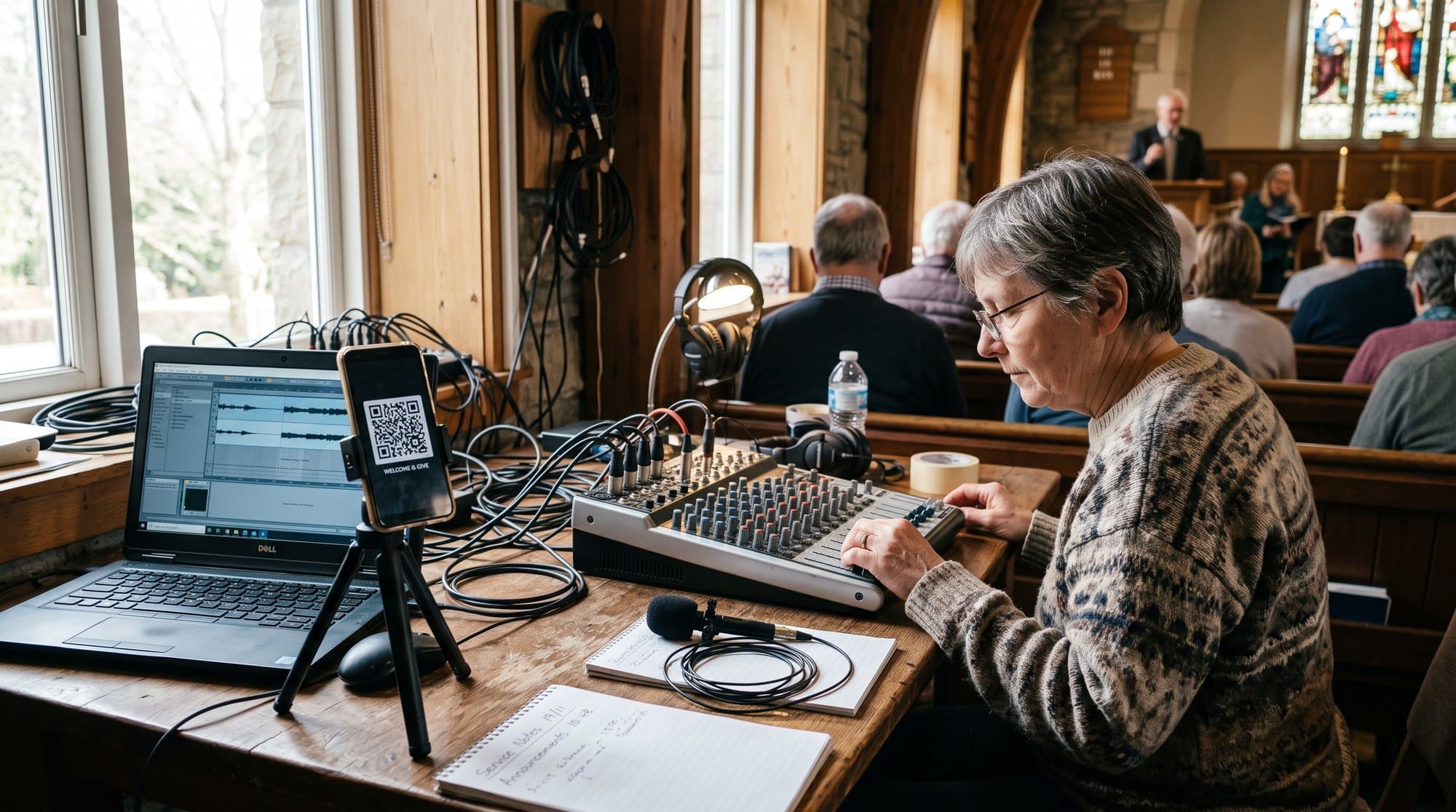
A church in Luton emails a translation vendor asking for a quote to cover two languages on a Sunday. The reply comes back priced for a UN summit: booths, a technician, two interpreters per language, minimum four hours. The number on the page is £1,200. The church has ninety people and two Farsi speakers.
This happens constantly, because most of the internet's "church translation cost" content is written by people selling conference equipment. The real range is much wider than that, and much cheaper at the bottom end than most churches assume.
This is a plain breakdown of what translating a church service actually costs in 2026, across the four real approaches: hiring a human interpreter, buying FM hardware, using an event interpretation platform, and using AI subscription software. It expands on Voco's own church translation cost page with the full worked numbers. Prices checked August 2026, UK-focused with US comparisons where it's useful, and I'll flag anywhere a number is a typical range rather than a fixed quote.
Full disclosure: I built Voco, one of the tools mentioned here. I've tried to keep the numbers honest even where they don't flatter it.
The four ways to translate a service
Almost every church ends up choosing between these:
- A human interpreter, live in the room or via a headset feed, translating what the preacher says as they say it.
- FM/RF hardware: a transmitter on the preacher and wireless receivers with headsets for listeners, usually paired with a human interpreter speaking into the transmitter.
- An event interpretation platform built for conferences, such as Wordly or Interactio, priced by usage.
- AI subscription software built for weekly recurring use, where the congregation scans a QR code or opens a link on their own phone.
They're not mutually exclusive. Plenty of churches run a human interpreter for their two biggest languages and AI software as a safety net for everything else.
Human interpreter costs
UK rates for a professional interpreter doing face-to-face work sit around £45 an hour as a national median, according to guidance cited by the Diocese of London, though most interpreters charge a minimum call-out of two to three hours regardless of how long the service actually runs. A rough guide from one UK interpreting agency prices a half-day (up to 3.5 hours including travel) at £170, and a full day (up to 7 hours) at £320, plus VAT and mileage.
BSL interpreting runs higher: a Royal Greenwich council rate card lists £185 for a 1-3 hour booking, before travel. Sessions over 45 minutes or anything doctrinally dense typically need two interpreters working in relay, which roughly doubles that.
Do the annual maths for a weekly Sunday service:
- One interpreter, one language, 52 Sundays, £170/half-day average: £8,840/year
- Two languages needing two interpreters: £17,680/year
- BSL alone, weekly, minimum 1-3hr rate: £9,620/year, before the second-interpreter requirement for longer services
Most churches solve this with a volunteer bilingual member instead of a paid interpreter, and that's genuinely the right call for many congregations. It isn't free, though.
Hardware costs (FM systems)
An FM or RF translation system (a transmitter clipped to the preacher, wireless receivers and headsets handed to listeners) is the classic solution, and it needs a human interpreter speaking into it. The hardware itself is a one-off cost, not a subscription.
Entry-level kits (one transmitter, 5-10 receivers) from Retekess run $66-$180 on Amazon and the manufacturer's own site. Scale up to a 30-60 receiver setup with a charging case and you're at $300-$2,300 depending on range, channel count and build quality. Conference-grade rental firms charge $145-$550 per use-day for equivalent kit if you don't want to own it, which only makes sense for occasional events, not weekly use.
The three-year total cost of ownership for a small church (say, a 10-receiver kit) looks like this:
- Hardware: ~£150-£400 one-off (converting from typical USD retail)
- Replacement batteries and lost/damaged receivers: budget 10-15% of hardware cost per year
- Still need a human interpreter to speak into the transmitter, so add those costs on top
FM hardware is a genuinely good, low-tech option if you already have an interpreter and just need to get their voice to people wearing headsets across a big room. It solves a distribution problem, not a translation problem.
Event platform costs (Wordly-style)
Wordly, the market leader here, doesn't publish a flat per-minute rate. Its model is a 12-month hours package, minimum 10 hours, and you only pay for the minutes a session actually runs (no rounding up). Wordly's own pricing page emphasises savings of "up to 90%" versus human interpreters, and third-party estimates (unverified: Wordly doesn't publish this figure directly) put per-hour pricing somewhere in the €45-55/hour range for smaller packages, dropping with volume.
Competitors in the same category, priced in August 2026:
- Interactio: monthly plan £89-£240-ish (converting from $125-$321) for the platform, plus AI translation billed separately at $45-99/hour per language
- Glossa: $99-$499/month depending on translation-hours included (25-250 hrs/month)
- OneAccord: $150/month for 5 hours across 5 languages, or $40/hour for a one-off session
Run the maths for a weekly Sunday service, one hour, one language, on a usage-based platform at a rough $50-90/hour: that's $2,600-$4,700 a year just for the AI translation component, before any platform/seat fee. These tools are built and priced for conferences that run occasionally and need many languages simultaneously, not for a service that happens every single week.
AI subscription costs (the flat-fee tier)
The newer category, software built specifically for a recurring weekly service and priced as a flat weekly or monthly subscription rather than by the hour, sits meaningfully cheaper for exactly this use case, because a church doesn't need conference features (multi-track sessions, delegate microphones, interpreter booths) it will never use.
This is Voco's tier: £6/week (Starter plan) or £12/week (Church plan), plus VAT, with translation available in 200+ attendee languages and no app required (attendees scan a QR code and it opens in their phone's browser). Starter allows 1-2 language groups per service; Church makes all supported languages available and adds OBS, ProPresenter and vMix integrations for churches that stream. There's a 7-day free trial with no card required.
Annualised, that's £312/year (Starter) or £624/year (Church): a fraction of the interpreter, hardware-plus-interpreter, or event-platform costs above, for the specific job of a weekly service in unlimited languages rather than a handful.
The big table: all four, one year
| Approach | Typical annual cost (1 language, weekly) | Best for |
|---|---|---|
| Human interpreter (freelance) | £8,800-£17,700 | Doctrinally precise, emotionally present translation for your top 1-2 languages |
| FM hardware + interpreter | £150-£400 hardware + interpreter cost above | Getting an interpreter's voice across a large room |
| Event platform (Wordly-style) | $2,600-$4,700+ (AI component alone) | Occasional conferences, multi-track events, not weekly services |
| AI subscription (flat-fee) | £312-£624 | Every Sunday, unlimited languages, small team, no dedicated AV budget |
- A single freelance interpreter costs roughly 20-40x more per year than a flat-fee AI subscription for the same weekly slot.
- FM hardware is cheap to buy but still needs a human voice behind it. It's a delivery method, not a translation method.
- Event platforms are the right tool for a one-off conference, wrong tool priced for a recurring Sunday.
- Flat-fee AI subscriptions are the only option in this table priced for "every week, forever" rather than "per event."
Hidden costs nobody puts in the quote
The sticker price is never the whole story. Budget time and attention for:
- Volunteer time. Someone has to set up the mic feed, test the system, and be the person who fixes it when it breaks mid-service. That's not free even if nobody's writing an invoice.
- Training. A new volunteer needs 15-30 minutes to learn any system, human or software. Multiply by staff turnover.
- Replacement hardware. Receivers get left in coat pockets and washed. Batteries die. Budget for it if you go the FM route.
- The cost of doing nothing. A visiting family who can't understand a word of the service and never comes back is a cost too, just one that doesn't show up on an invoice.
What this actually means for your budget
If you've got the money and a genuinely mixed congregation across two or three main languages, a human interpreter is still the warmest, most accurate option and deserves real consideration. If you're running occasional big events with delegates from a dozen countries, an event platform like Wordly earns its price. But if the job is "every single Sunday, unknown mix of languages, no dedicated AV budget," the flat-fee AI tier is priced for exactly that problem in a way none of the others are.
I have worked with churches on staff and from the outside for a long time, and the thing that kills a good idea in a church meeting is not an expensive number. It is an unpredictable one. If it might be one figure this month and several times that next month, it does not get signed off, because the person putting their name to it cannot answer the obvious question.
So Voco is a flat weekly figure. Six pounds a week to have the sermon available in whatever language somebody needs, and captions in English for anyone who is hard of hearing. A treasurer can take that into a meeting and have it agreed in one go.
Church weeks are not uniform, obviously. An event appears, a family arrives, suddenly there are more people than usual. If that happens for a week or two, nothing gets cut off. If it becomes the pattern, that is a conversation about moving to the plan that actually fits, not a surprise on an invoice.
If your church just needs Sunday sorted without a five-figure annual line item, that's the gap I built Voco to close. Try the free week and see what it actually costs you to run.
Frequently asked questions
What should churches know about the four ways to translate a service?
1. A human interpreter, live in the room or via a headset feed, translating what the preacher says as they say it. 2. FM/RF hardware: a transmitter on the preacher and wireless receivers with headsets for listeners, usually paired with a human interpreter speaking into the transmitter. 3. An event interpretation platform built for conferences, such as Wordly or Interactio, priced by usage. 4. AI subscription software built for weekly recurring use, where the congregation scans a QR code or opens
What should churches know about human interpreter costs?
UK rates for a professional interpreter doing face-to-face work sit around £45 an hour as a national median, according to guidance cited by the Diocese of London, though most interpreters charge a minimum call-out of two to three hours regardless of how long the service actually runs. A rough guide from one UK interpreting agency prices a half-day (up to 3.5 hours including travel) at £170, and a full day (up to 7 hours) at £320, plus VAT and mileage.
What should churches know about hardware costs (fm systems)?
An FM or RF translation system (a transmitter clipped to the preacher, wireless receivers and headsets handed to listeners) is the classic solution, and it needs a human interpreter speaking into it. The hardware itself is a one-off cost, not a subscription.
What should churches know about event platform costs (wordly-style)?
Wordly, the market leader here, doesn't publish a flat per-minute rate. Its model is a 12-month hours package, minimum 10 hours, and you only pay for the minutes a session actually runs (no rounding up). Wordly's own pricing page emphasises savings of "up to 90%" versus human interpreters, and third-party estimates (unverified: Wordly doesn't publish this figure directly) put per-hour pricing somewhere in the €45-55/hour range for smaller packages, dropping with volume.
First published on Medium.