2026-09-21 · 10 min read
Deaf and Hard-of-Hearing Church Accessibility: Loops, Captions and FM Compared
Hearing loops, FM systems, live captions and sign interpretation, compared honestly on cost, coverage and who they actually serve.
By Josh Stannard, founder of Voco
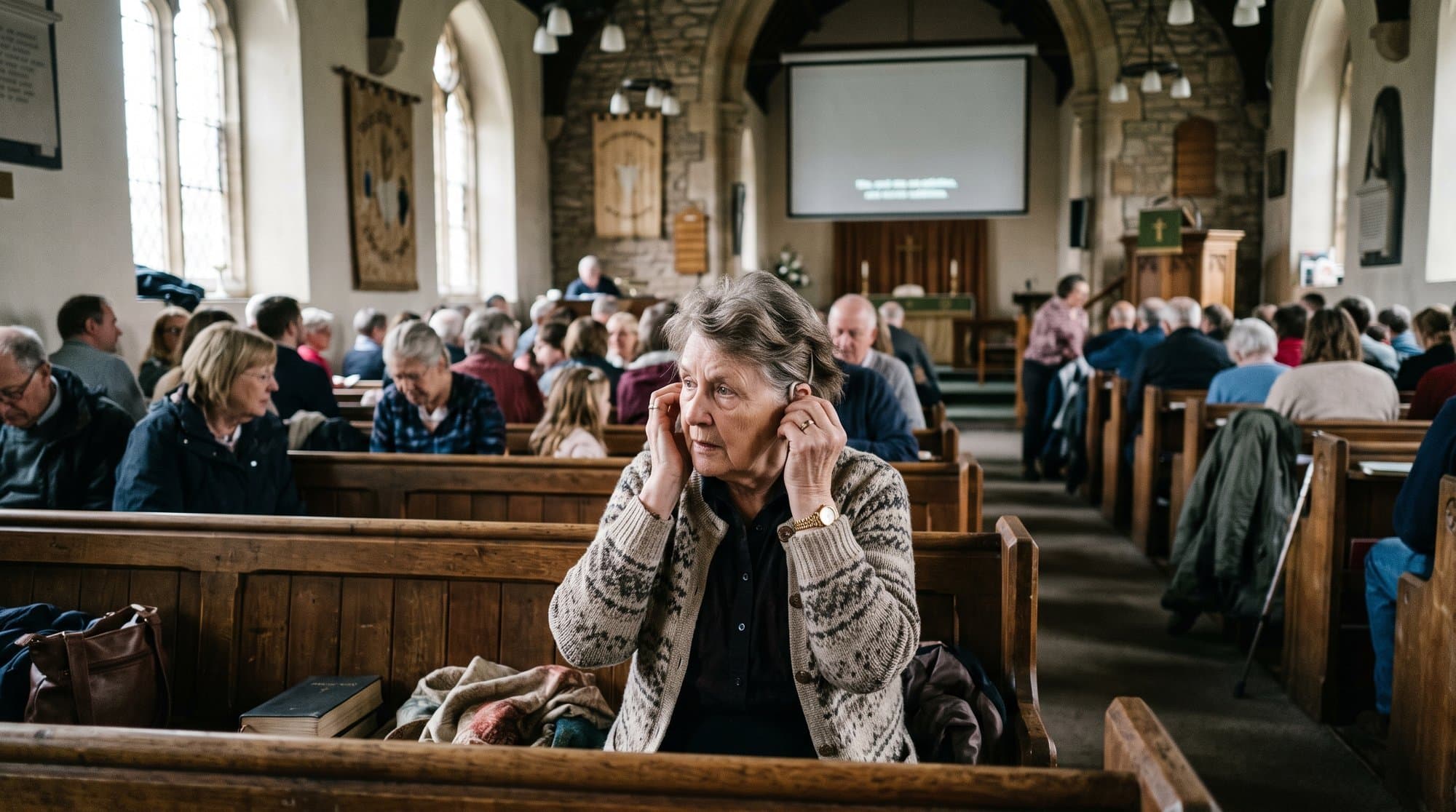
There's a moment in a lot of churches where someone leans over to their partner and asks them to repeat what was just said. It happens quietly, most weeks, and most churches never notice it's happening at all.
Roughly 1 in 6 adults in the UK have hearing loss of at least 25dB in their better ear, according to RNID, the UK's leading deafness and hearing loss charity. That's not a niche accessibility concern. Statistically, it's several people in every congregation of fifty, more once you factor in that over half the population aged 55 or older has some hearing loss, and almost 80% of people over 70 do. If your church has an older congregation, which most UK churches do, hearing loss is not the exception. It's the room.
This article compares the four real options for church accessibility: hearing loops, FM and assistive listening kits, live captions, and sign language interpretation. It gives real cost ranges, checked in August 2026, and it tries hard not to pretend one option replaces the others. It doesn't. They serve different people, sometimes the same person on different days, and the honest answer for most churches is a mix, not a single purchase.
The scale nobody talks about
RNID's most recent recalibration (using 2021-22 census data) puts the number of UK adults with some degree of hearing loss at 18 million, once you include people with hearing loss in one ear and milder degrees of loss. Their more conservative estimate, using a stricter threshold, is that 1 in 6 adults have hearing loss of at least 25dB in their better ear, roughly 11 million people, including about 6.7 million who could benefit from a hearing aid and around 900,000 who have severe or profound deafness.
Separately, there's a distinct Deaf community, capital D, for whom British Sign Language (BSL) is a first or preferred language, not English with the volume turned down. The two groups overlap in places and diverge sharply in others. That distinction matters for everything that follows, so hold onto it.
Neither of these facts shows up on a typical church accessibility audit, because hearing loss doesn't look like a wheelchair ramp. Nobody's filling in a form. People just quietly stop coming, or they come and miss half of what's said, or a family member becomes an unofficial, unpaid interpreter every single Sunday.
Option by option
Hearing loops
A hearing loop (also called an induction loop) is a wire that runs around a room, connected to an amplifier fed from the sound desk. It creates a magnetic field that any hearing aid with a telecoil, which is most modern hearing aids, picks up directly. No app, no receiver to borrow, no separate device. The user just switches their hearing aid to the T setting.
Cost: a small counter or reception loop runs about £250 to £400 installed. A full room loop for a church-sized space, professionally installed with a dedicated amplifier, typically runs £2,000 to £4,000 as a standalone project, often less if it's bundled into a wider sound system install. Ongoing cost is low: an annual check and occasional PAT test, but no per-user running cost.
Coverage: only reaches telecoil hearing aid users within the looped area, and older stone-and-pillar buildings can create "dead spots" that need a proper site survey to avoid. It's genuinely excellent for the people it serves, and invisible to everyone else, which is part of its appeal.
FM and assistive listening kits
An FM system uses a transmitter clipped to the speaker's mic feed and small personal receivers with headphones, earbuds or neckloops handed out to attendees. No telecoil hearing aid required, which makes it more flexible than a loop for visitors and for anyone without a hearing aid at all.
Cost: a basic portable kit for a small venue, one transmitter and two to four receivers, runs roughly $970 to $2,000 (about £770 to £1,600) depending on the number of receivers and whether they're rechargeable. There's an ongoing cost most churches underestimate: batteries, cleaning between users, and the near-certainty that receivers will occasionally go home in someone's coat pocket and need replacing.
Coverage: works for anyone, hearing-aid user or not, but requires a person to physically hand out and collect receivers each week, which is real volunteer labour that a loop doesn't ask for.
Live captions
Live captions display spoken words as text, on a screen at the front, on personal phones, or on a livestream. The tech has shifted a lot in the last few years: what used to require a paid stenographer or a clunky hardware box can now run from a phone's browser, no app download, no hearing aid, no receiver to return.
Cost: this is the newest and cheapest category. Software-based live captioning services for churches typically run in the £6 to £12 per week range for a weekly service, with no hardware to buy or maintain. There's no upfront cost comparable to a loop or FM kit; it's a subscription, which changes the maths for smaller churches especially.
Coverage: works for anyone who can read and has a phone or can see a screen, which includes hard-of-hearing people who don't wear hearing aids, visitors, people whose first language isn't English if the captions also translate, and people simply sitting too far back to hear clearly. It doesn't work for someone who can't read English captions and doesn't use spoken language as their primary mode of communication at all.
Sign interpretation
A qualified BSL/English interpreter translates spoken content into sign language live, in person or via a screen. For Deaf BSL users, this isn't a nice-to-have alongside captions, it's often the only format that delivers full, nuanced, natural-language access, because BSL is a distinct language with its own grammar, not a signed version of English.
Cost: UK BSL interpreter rates vary by region and qualification level but generally fall between £40 and £80 per hour, with most bookings requiring a minimum of 2 to 3 hours. NUBSLI's regional fee guidance for 2026/27 shows full-day rates for qualified (RSLI) interpreters ranging from roughly £335 in Scotland to £375 in London, with half-day rates typically 50 to 55% of the full-day figure. For a single Sunday service booking, expect somewhere between £150 and £400 depending on region, duration and interpreter experience.
Coverage: this is the one option on this list built for a specific, distinct community rather than a general accessibility fix. It's also the option most likely to be treated as an afterthought or a one-off, which is worth naming honestly, because it shouldn't be.
The comparison table
| Option | Upfront cost | Ongoing cost | Who it serves | Install effort |
|---|---|---|---|---|
| Hearing loop | £2,000-£4,000 (room), £250-£400 (counter) | Low (annual check) | Telecoil hearing aid users, in-room | Professional install, building survey |
| FM/assistive listening kit | £770-£1,600 | Batteries, receiver replacement, weekly handout labour | Anyone, hearing aid or not | Plug-and-play, some volunteer time |
| Live captions | None | £6-£12/week (prices checked August 2026) | Anyone with a phone or screen, incl. visitors and non-native readers | Minutes, no hardware |
| BSL/ASL interpretation | None | £150-£400 per service (UK, 2026) | Deaf BSL/ASL users specifically | Booking a qualified interpreter |
In short:
- Hearing loops are cheap to run once installed, but only help telecoil hearing aid users, and only inside the looped area.
- FM kits reach anyone but come with real weekly labour, cleaning and loss of kit.
- Live captions have no upfront cost and reach the widest range of people, including visitors, but don't replace sign language for Deaf BSL users.
- Sign interpretation is the only option that delivers full first-language access for the Deaf community, and it's priced per booking, not per week.
A worked example makes the trade-offs concrete. Picture a 90-person church in a Victorian building, roughly a third of the congregation over 60. A room hearing loop, professionally installed given the building's stone walls and pillars likely need a proper survey, might land around £3,000 upfront, then a few hundred pounds a year for checks. That serves everyone in the room with a telecoil hearing aid, permanently, with almost no ongoing labour. Live captions for the same church run roughly £312-£624 a year in subscription cost, no upfront spend, and additionally reach the two visiting families who don't speak English as a first language, which a loop never will. Booking a BSL interpreter for one Sunday costs roughly the same as several months of captions. None of these numbers make the decision for you. They just show why "which one should we buy" is the wrong question before "who actually needs what" has been answered.
Why captions became the default answer
The honest reason captions have become so many churches' first accessibility purchase isn't that they're better than loops or interpretation. It's that almost everyone already owns the receiving device. A phone in a pocket is a caption display, a translation screen, and a large-text reader all at once, and it costs the church nothing extra to reach it. That's a genuinely different economics to a loop that needs building work, or an FM kit that needs a volunteer standing at the door each week.
There's a second reason, less talked about: live captioning and live translation, when they run on the same pipeline, serve two different accessibility needs from one setup.
Full disclosure: I built Voco, one of the tools mentioned in this article. Voco runs live captions and translation from one pipeline, into a browser on any phone, with no app to download and 200+ supported attendee languages, for £6-12 a week depending on plan (prices checked August 2026). It's a genuinely good fit for the caption side of this comparison. It is not a substitute for a hearing loop if your congregation is mostly telecoil hearing aid users, and it is absolutely not a substitute for a BSL interpreter if your church has Deaf members who sign. Anyone selling captions as a replacement for sign interpretation is selling you something that doesn't do what they're claiming.
A dignity note: ask your deaf members first
Here's the thing an accessibility comparison table can't capture: the right answer for your church is not the option that scores best on this page. It's the option your actual deaf and hard-of-hearing members say they want, and those might be different people wanting different things.
A hard-of-hearing member who lost hearing gradually in later life, and has never learned BSL, will likely be well served by a loop or by captions. A Deaf member for whom BSL is their first language will not feel served by a caption screen the same way, however good the text is, because reading captions in a second language while trying to worship is a different cognitive load to receiving a sermon in your first language, signed, with the emotional and grammatical nuance BSL carries and English text doesn't.
Deaf ministry writers have made this point for years: captions are useful, sometimes essential, but they are not equivalent to sign interpretation, and offering captions instead of interpretation because it's cheaper isn't accessibility, it's a cost-saving decision dressed up as one. The RNID's own guidance is careful to note there's no single consensus figure for the number of BSL users in the UK, precisely because BSL usage and hearing loss are different things measured differently, and lumping them into one accessibility line item is exactly the mistake worth avoiding.
So before you buy anything: ask. Find out who in your congregation, and in your wider community, needs what. Some will want a loop. Some will want captions on their own phone rather than a big screen, for privacy. Some will want an interpreter booked for every service, not just Christmas and Easter. The honest starting point for church accessibility isn't a purchase order. It's a conversation.
That conversation is also the moment to ask a harder question: is the church prepared to book an interpreter regularly, not as a special-occasion gesture but as a standing part of how services run, if that's what's being asked for. A one-off interpreter at Christmas photographs well and solves nothing for the other fifty-one Sundays. Deaf members who've experienced churches treating sign interpretation as a seasonal extra, rather than ongoing provision, notice the difference, and it shapes whether they come back.
If your church runs weekly services in more than one language already, this comparison sits alongside a wider question about how church translation cost works across every option, not just accessibility ones, and it's worth reading both together before you commit budget.
You can see how Voco's captioning and translation setup works, and what it costs, at voco.church/deaf-hoh and voco.church/assistive-listening-church. The setup documentation, including how captions integrate with an existing loop or FM system rather than replacing it, is at voco.church/docs/deaf-hoh-captioning.
Ask your deaf members first. Then buy the thing they actually need.
Frequently asked questions
What should churches know about the scale nobody talks about?
RNID's most recent recalibration (using 2021-22 census data) puts the number of UK adults with some degree of hearing loss at 18 million, once you include people with hearing loss in one ear and milder degrees of loss. Their more conservative estimate, using a stricter threshold, is that 1 in 6 adults have hearing loss of at least 25dB in their better ear, roughly 11 million people, including about 6.7 million who could benefit from a hearing aid and around 900,000 who have severe or profound de
What should churches know about option by option?
A hearing loop (also called an induction loop) is a wire that runs around a room, connected to an amplifier fed from the sound desk. It creates a magnetic field that any hearing aid with a telecoil, which is most modern hearing aids, picks up directly. No app, no receiver to borrow, no separate device. The user just switches their hearing aid to the T setting.
What should churches know about the comparison table?
In short: - Hearing loops are cheap to run once installed, but only help telecoil hearing aid users, and only inside the looped area. - FM kits reach anyone but come with real weekly labour, cleaning and loss of kit. - Live captions have no upfront cost and reach the widest range of people, including visitors, but don't replace sign language for Deaf BSL users. - Sign interpretation is the only option that delivers full first-language access for the Deaf community, and it's priced per booking, n
What should churches know about why captions became the default answer?
The honest reason captions have become so many churches' first accessibility purchase isn't that they're better than loops or interpretation. It's that almost everyone already owns the receiving device. A phone in a pocket is a caption display, a translation screen, and a large-text reader all at once, and it costs the church nothing extra to reach it. That's a genuinely different economics to a loop that needs building work, or an FM kit that needs a volunteer standing at the door each week.
First published on Medium.