2026-09-24 · 8 min read
Bilingual Church Service Formats That Actually Work (And Two That Don't)
Alternating verses, silent translation, full repetition, the bilingual formats that keep both language groups engaged, with the real timing maths behind each.
By Josh Stannard, founder of Voco
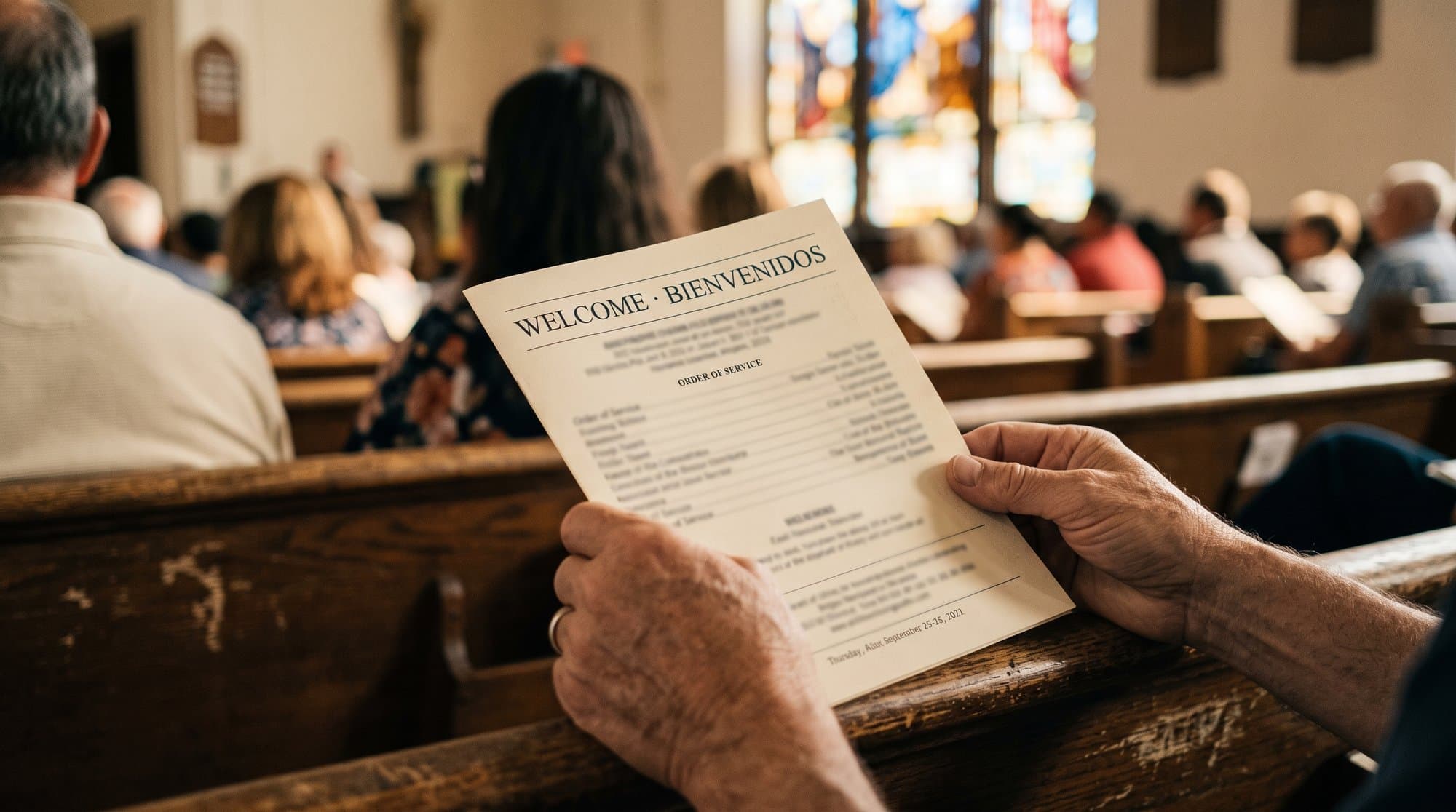
A 75-minute service that fully translates everything doesn't become a 75-minute bilingual service. It becomes a 135-minute service, and everyone in the room feels every extra minute of it, the English speakers waiting through the Spanish, the Spanish speakers waiting through the English, both groups quietly checking their watches by minute 100.
This is the maths nobody runs before they commit to "we'll just translate everything," and it's the reason more bilingual services fail from exhaustion than from any deeper problem. Below are four formats that hold a bilingual congregation together without doubling the clock, and two that churches keep trying anyway, for understandable reasons, before quietly abandoning them.
The repetition trap
Here's the arithmetic. A 20-minute sermon, translated sentence by sentence, doesn't take 20 minutes plus a bit for translation lag. It takes close to 40, because every sentence is now said twice, at normal pace, with the translator's timing on top. Stack that across a full service, welcome, readings, songs, sermon, prayers, notices, and a service designed to run 75 minutes creeps toward two and a quarter hours.
The effect on attention is worse than the effect on the clock. Congregation members who understand the first language sit through the second passively, and vice versa, each group is actively engaged for roughly half the service and passively waiting for the other half. That's not inclusion. It's two monolingual services stapled together and called one bilingual one.
Children feel this hardest. A ten-year-old who understands neither the second language nor the reason the service keeps stopping and restarting is the first person to disengage, and parents notice long before leadership does. Families with young children are also disproportionately likely to simply stop coming to a service that's outgrown their patience, which means the repetition trap doesn't just cost attention on the day, it costs attendance over time, quietly, without anyone naming why.
The four formats below all solve this the same way: they reduce how much gets said twice, not by cutting content, but by choosing where translation happens with more precision.
Four formats that work
1. Alternating-language elements
Different parts of the service run in different languages, without translating each part into the other. The welcome in English, the opening prayer in Spanish, the first reading in English, the second in Spanish, and so on through the service.
Timing: no time penalty at all, each element takes the same length it would in a monolingual service, because nothing's said twice.
Trade-off: each language group only fully understands roughly half the service unassisted. Works best paired with printed bilingual text for the elements people don't speak, so they can follow along even when they can't hear their own language live.
Worth knowing: which elements go in which language sends a signal, whether intended or not. If the sermon is reliably in the majority language and only the announcements rotate, that pattern communicates something about which language "matters" more, regardless of what leadership says out loud. Rotate the weightier elements, not just the welcome and notices, if genuine parity is the goal.
2. Silent translation via captions or text
The service runs at full pace and full length in one primary language. Anyone who needs the other language reads it, live captions on a phone, a printed side-by-side order of service, or a translated slide alongside the English one.
Timing: zero time penalty. The spoken service runs exactly as long as a monolingual one would; the translation layer runs in parallel, not in sequence.
Trade-off: this depends entirely on the accuracy and immediacy of whatever's producing the text. Printed bulletins are fixed and can't cover an unscripted moment (a spontaneous prayer request, a joke, a change of plan from the front). Live captioning tools solve that gap, this is squarely Voco's lane, and it's the format that scales best as more languages get added, since adding a fourth or fifth language doesn't add a single minute to the service. Full disclosure: I built Voco, one of the tools mentioned here. It's not the right fit for every bilingual church, a small congregation with one clearly bilingual leader delivering their own translated remarks live often gets a warmer result than software, precisely because there's no substitute for a known voice.
Worth knowing: this format asks the congregation to hold a phone during parts of the service, which some older members and some traditions find genuinely uncomfortable. It's worth naming explicitly why the phone's there, following the service, not checking messages, rather than assuming everyone will intuit the difference.
3. Bilingual songs and sung responses
Music alternates by verse or chorus rather than running two separate songs. A worship set sings verse one in English, verse two in Spanish, chorus in both simultaneously, a format documented across several established bilingual congregations, including practices detailed by Lifeway Research's overview of bilingual worship elements.
Timing: modest penalty, perhaps 10-20% longer per song than a monolingual set, since choruses often repeat in both languages. Manageable within a normal worship set length.
Trade-off: requires songs actually written or well-adapted bilingually. Word-for-word translation of English worship songs into Spanish rarely scans against the original melody, the phrasing doesn't fit, and it shows. Investing time in finding or writing genuinely bilingual songs pays off far more than translating your existing set list.
Worth knowing: a worship team that's only ever sung in one language needs real rehearsal time before this works live, not just a lyric sheet handed out five minutes before the service. Budget at least a few weeks of practice before debuting a bilingual set, and expect it to feel rough the first couple of Sundays regardless of preparation.
4. Short bilingual summary, not full translation
The sermon (or any spoken segment) is delivered in one language, then followed by a genuinely short summary, not a full re-preach, in the second language. The preacher hits the same core point, illustrated differently if needed, in two or three minutes rather than a line-by-line re-run.
Timing: adds maybe 15-20% to sermon length rather than doubling it. A 20-minute sermon becomes roughly 24-25 minutes with the summary, not 40.
Trade-off: the second-language group gets the headline, not the full texture, illustrations, asides, the preacher's particular way of building an argument. Works well when paired with printed notes or a fuller translated transcript made available afterwards for anyone who wants the whole thing.
Two that don't (and why churches keep trying them)
Full sentence-by-sentence translation
The format most churches reach for first, because it feels the most "complete", nothing gets lost, everything's said in both languages. It's also the one most likely to exhaust a congregation within a few months, for exactly the timing reasons above. Churches keep trying it because it feels like the fair, thorough option; they abandon it because a service that regularly runs two hours quietly bleeds attendance, especially among families with young children and older members.
Two entirely separate, simultaneous streams in one room
Two services happening at once in the same physical space, one language group listening to a live interpreter through headsets while the room's spoken content is nominally "shared." In practice this produces two congregations occupying the same chairs without ever really worshipping together; the room looks integrated, but the experience isn't. Churches try it because the room-sharing feels efficient. It fails because a shared room isn't the same as a shared service, and congregations notice the difference over time even when leaders don't name it.
The Sunday-ready comparison
| Format | Time penalty | Best for | Weakness |
|---|---|---|---|
| Alternating-language elements | None | Roughly equal-sized language groups | Each group misses ~half unassisted |
| Silent translation (captions/text) | None | Growing number of languages, small teams | Depends on translation accuracy/immediacy |
| Bilingual songs, verse-alternating | +10-20% (music only) | Congregations with a strong worship team | Needs genuinely bilingual songs, not translated ones |
| Short bilingual summary | +15-20% (sermon only) | One dominant + one smaller language group | Second group gets headline, not full texture |
| Full sentence-by-sentence translation | +80-100% | Rarely, high-stakes single events only | Doubles service length, exhausts attention |
| Simultaneous separate streams, one room | None (but hollow) | Almost never recommended | Two congregations, one room, no real unity |
In short:
- If your service is already running long, silent translation via captions adds languages without adding minutes.
- Alternating elements works well when your two groups are roughly the same size and you want genuine parity.
- Bilingual songs and short summaries are the lowest-risk additions to an existing monolingual service.
- Avoid full sentence-by-sentence translation as a permanent format, it's fine for a single special occasion, exhausting as a weekly habit.
Making the switch
Changing formats is a communication problem as much as a logistics one. Congregations that have grown used to full translation, however exhausting, can read a switch to silent captioning as "doing less" for the language group being served, even when the actual comprehension improves. Name the change explicitly before you make it: explain that the goal is a service both groups can actually sustain attending, not a reduction in care. Trial it for a defined period, four to six weeks, and ask for feedback directly from people in the affected language group, not just from leadership guessing on their behalf.
Our house is a mix. English is what we speak day to day, but my wife speaks Spanish, and we put the television on in Spanish for the children, or Spanish music on, so they pick it up. I learn some of it myself just from hearing her.
What I have noticed is that alternating is not the same as diluting. Nobody at home feels short-changed on the days it is mostly English, because it is understood as a rhythm rather than a ranking. A congregation can hold the same idea. It just needs somebody to say out loud that this is what is happening, rather than letting people work it out for themselves.
The right format is the one your congregation can actually sustain past the first six months, not the one that looks most complete on paper. Read more on multilingual worship and see how live translation works if silent captioning looks like your fit.
Frequently asked questions
What should churches know about the repetition trap?
Here's the arithmetic. A 20-minute sermon, translated sentence by sentence, doesn't take 20 minutes plus a bit for translation lag. It takes close to 40, because every sentence is now said twice, at normal pace, with the translator's timing on top. Stack that across a full service, welcome, readings, songs, sermon, prayers, notices, and a service designed to run 75 minutes creeps toward two and a quarter hours.
What should churches know about four formats that work?
Different parts of the service run in different languages, without translating each part into the other. The welcome in English, the opening prayer in Spanish, the first reading in English, the second in Spanish, and so on through the service.
What should churches know about two that don't (and why churches keep trying them)?
The format most churches reach for first, because it feels the most "complete", nothing gets lost, everything's said in both languages. It's also the one most likely to exhaust a congregation within a few months, for exactly the timing reasons above. Churches keep trying it because it feels like the fair, thorough option; they abandon it because a service that regularly runs two hours quietly bleeds attendance, especially among families with young children and older members.
What should churches know about the sunday-ready comparison?
In short: - If your service is already running long, silent translation via captions adds languages without adding minutes. - Alternating elements works well when your two groups are roughly the same size and you want genuine parity. - Bilingual songs and short summaries are the lowest-risk additions to an existing monolingual service. - Avoid full sentence-by-sentence translation as a permanent format, it's fine for a single special occasion, exhausting as a weekly habit.
First published on Medium.